




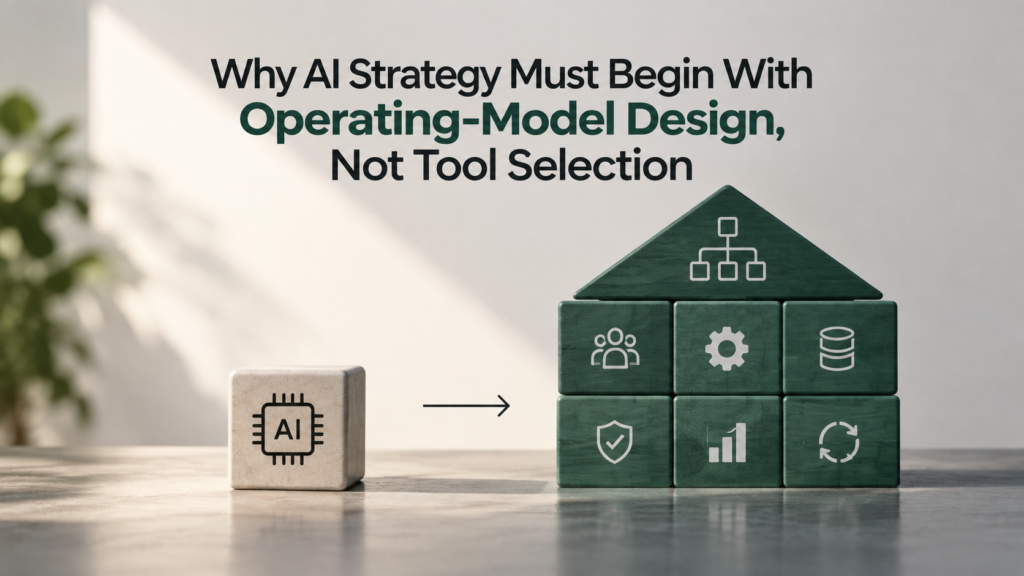
Many enterprise AI initiatives begin with a technology question. Leadership teams compare models, copilots, automation platforms, agent frameworks, and software vendors to determine what the organisation should adopt. These decisions matter, but they are more useful after the organisation has defined how AI is expected to fit into the way work is performed.
AI systems interact with people, business processes, data, software, policies, approval structures, and existing responsibilities. Introducing AI without defining those relationships can create technically capable systems that have no clear place within normal operations or that depend on people to resolve gaps the implementation failed to address.
An AI operating model provides that structure. It defines how people, processes, technology, decision rights, controls, and ownership work together once AI becomes part of the organisation. For companies moving beyond isolated experiments, operating-model design creates the foundation for turning AI strategy into sustained operational capability.
What an AI Operating Model Defines
An operating model describes how an organisation converts strategic priorities into day-to-day execution. It determines how work moves across teams, who owns decisions, which systems support the process, how resources are allocated, how performance is measured, and where accountability sits.
AI changes several parts of that structure. A system may retrieve information, analyse records, prepare recommendations, communicate with customers, update business applications, trigger workflows, or complete actions that were previously handled by employees. Once these capabilities are introduced, the organisation needs clear rules around what the system is authorised to do, what information it can access, which decisions remain with employees, how exceptions are escalated, and who remains accountable for the outcome.
These questions should influence system design from the beginning. McKinsey’s research on AI operating models found that organisations generating more value from AI were making broader changes across workflows, governance, organisational structures, capabilities, and technology rather than treating AI adoption as a standalone technology initiative.
The implication is that enterprise AI strategy cannot stop at deciding what to buy or build. It needs to define how AI will operate within the organisation.
Why Tool Selection Is a Weak Starting Point
Technology selection answers questions about capability. Teams can compare model performance, security requirements, integration options, deployment methods, pricing, speed, context limits, agent functionality, and vendor support.
These comparisons become more useful once the organisation knows what the technology needs to accomplish.
Consider a customer operations team evaluating an AI agent. The technical assessment may confirm that the agent can retrieve account information, generate responses, update CRM records, and call external services through APIs. The business still needs to decide which customer requests the agent can resolve, whether it can communicate directly with customers, which records it can change, whether it can issue credits or refunds, what financial limits apply, and when an employee must intervene.
Each of these choices changes the technical requirements. An agent that prepares replies for employee review needs a different control model from one authorised to communicate independently. A system allowed to make financial changes needs stricter permissions, logging, and approval mechanisms than one that only retrieves information.
Starting with the operating requirements gives teams a clearer basis for selecting the right technology rather than fitting business processes around a tool chosen too early.
Design the Workflow Before Choosing the AI
AI strategy should define how a business process is expected to work once AI is introduced. This requires looking at the end-to-end workflow rather than identifying isolated tasks that appear easy to automate.
Employee onboarding provides a useful example. A typical process may involve collecting employee information, creating accounts, assigning system permissions, arranging equipment, sharing policies, scheduling orientation sessions, answering questions, and updating HR applications.
An organisation could purchase separate AI tools for several of these activities without improving the overall process. Employees may still transfer information manually, coordinate across departments through email, repeat data entry, and resolve process failures themselves.
A workflow-led approach starts by mapping the complete process. Teams can identify what triggers each stage, which systems are involved, where information moves between teams, what decisions occur, where delays appear, and how exceptions are currently handled. This helps determine which business processes are suitable for automation and what form of AI implementation would create meaningful operational improvement.
Technology selection then becomes a response to a defined workflow instead of an attempt to fit a purchased tool into an existing process.
Define the Business Outcome Before the Technical Architecture
An AI initiative needs a business outcome that can be measured independently of the technology used to achieve it. Objectives such as “implement generative AI,” “deploy AI agents,” or “introduce an AI copilot” describe technical activity, but they do not define what should improve inside the organisation.
A business outcome is more concrete. A company may want to reduce customer onboarding time, shorten invoice-processing cycles, increase first-contact resolution, reduce manual reconciliation work, or decrease the time required to prepare management reports.
Once the outcome is clear, teams can examine which parts of the current process prevent that result and whether AI can address the actual constraint. This avoids spending engineering resources on automating tasks that have little effect on overall performance.
For example, automating report writing may save time at the end of a reporting cycle, but the impact will remain limited if employees still spend most of the cycle collecting, reconciling, and approving data. A stronger operating model links AI investment to a defined operational result and examines the full process required to produce it.
Establish Decision Rights Before Giving AI Authority
Traditional organisations assign decision rights through job responsibilities, reporting structures, approval limits, and company policies. AI systems need the same clarity when they are expected to take action.
Technical capability does not create business authority. An AI agent may be able to perform an action that the organisation has not authorised it to perform.
A finance workflow illustrates the distinction. AI could extract information from invoices, compare invoices with purchase orders, identify discrepancies, check payment terms, and prepare a recommendation. The organisation may permit automatic processing when the information matches and the transaction remains below a defined threshold, while high-value payments, unusual vendors, missing documentation, or material discrepancies still require employee review.
The operating model determines these boundaries, and the technical implementation translates them into permissions, workflow rules, approval steps, audit records, and escalation paths. Clear decision rights allow teams to use AI productively without creating unnecessary operational or financial risk.
Define Where Human Judgment Remains Necessary
AI operating-model design should establish how responsibilities are divided between employees and AI systems within each workflow. Some activities may be suitable for independent system execution, including information retrieval, classification, routine data updates, monitoring, document preparation, and predefined administrative actions where risk is limited and completion criteria are clear.
Other activities may operate within defined limits. An AI system could take action when confidence, transaction value, customer type, or another business condition falls within an approved range. Higher-risk decisions may remain with employees, including material financial commitments, contractual actions, sensitive employee decisions, high-value customer exceptions, or cases where the available information does not support an automated decision.
The appropriate division depends on the process rather than a universal standard for AI autonomy. Deloitte’s research on enterprise AI operating models found that technology leaders expect operating models to change as organisations address human-AI work orchestration, decision rights, governance, funding, and accountability.
These responsibilities are easier to implement when they are defined during process design rather than added after an AI system has already been built.
Assign Business and Technical Ownership
AI implementation often involves several teams. Operations may own the workflow, engineering may build integrations, IT may manage infrastructure, security may control access, data teams may maintain information sources, and legal or compliance teams may review risk.
Multiple teams can contribute to an implementation, but accountability still needs to be explicit. Each AI-enabled process should have a business owner responsible for the operational outcome and for deciding whether the system is performing as intended.
Technical ownership needs similar clarity. Someone needs responsibility for integrations, system performance, failures, model changes, workflow logic, monitoring, permissions, and maintenance.
These responsibilities become more important after deployment. When ownership is unclear, business teams may treat failures as engineering problems while engineering teams treat them as process issues. Defining ownership early gives the system a clear place within the organisation and reduces the risk of operational problems remaining unresolved between functions.
Determine Whether the Process Is Ready for AI
Operating-model design often exposes process weaknesses that technology cannot solve on its own. A workflow may depend on undocumented knowledge, incomplete data, disconnected systems, inconsistent practices across departments, or exception handling that relies on informal communication.
These conditions affect implementation quality. Before engineering work begins, teams should examine process clarity, data availability, decision rules, system access, ownership, exception handling, and risk. A structured AI automation readiness assessment can help identify gaps that need to be resolved before development begins.
This preparation reduces avoidable engineering work. Technical teams should not have to reconstruct undocumented business rules or discover basic process ownership halfway through implementation.
Plan the Integration Model Around Existing Systems
Most enterprise AI systems need to interact with the software already used across the organisation. An AI workflow may receive information through email, retrieve account history from a CRM, query an internal database, review documents in cloud storage, request approval through a communication platform, update an ERP system, and record the completed action in another application.
The AI model is one component within this broader environment. Operating-model design helps determine which integrations are required, who owns each system, what level of access the AI receives, how authentication is handled, where information should be written back, and what should happen when one of the connected systems becomes unavailable.
This approach can reduce unnecessary software replacement. Many organisations can introduce AI by connecting existing applications through new workflow and intelligence layers rather than replacing their entire technology stack.
The architecture should reflect the process the company needs to operate rather than forcing the process to follow the structure of a newly purchased application.
Treat Governance as Part of Workflow Design
Governance has more practical value when it is expressed through system behaviour rather than left only in policy documents.
If company policy requires human approval for sensitive financial actions, the workflow needs an approval step, a clear definition of which actions fall into that category, an authorised reviewer, an escalation path, and a record of the decision. If access to employee information is restricted, the system needs permissions that prevent AI from retrieving data outside its authorised scope.
Traceability requires the same level of implementation. If the organisation needs to know what information an AI system used, what decision it made, what action followed, and whether a person approved it, those events need to be captured as part of the workflow.
This relationship between policy and system design is another reason operating-model decisions should precede tool selection. Governance requirements can influence architecture, integration methods, deployment environments, permissions, and monitoring.
Decide How the System Will Be Managed After Launch
The operating model should cover the full lifecycle of the AI system rather than ending at deployment. Business processes change, applications are updated, APIs change, new exceptions appear, policies evolve, and model behaviour may shift after an update.
Someone needs responsibility for evaluating these changes and maintaining the workflow. Post-deployment work may include reviewing failures, monitoring output quality, updating business rules, maintaining integrations, adjusting prompts or agent logic, managing access permissions, testing model changes, examining escalation patterns, and measuring business performance.
This makes delivery-model selection part of operating-model design. Some companies may assign this responsibility to an internal engineering team, while others may need dedicated technical capacity embedded closer to the business function. Organisations comparing staff augmentation and project outsourcing for AI automation should assess which model provides the continuity, ownership, and ongoing engineering support required across the full lifecycle of the system.
The implementation model should reflect what happens after launch, not just how quickly the initial version can be built.
Build Reusable Capabilities Across AI Initiatives
An effective enterprise AI operating model should make future implementations easier. The first projects may require significant work to establish authentication, system access, evaluation methods, monitoring, approval mechanisms, security patterns, documentation standards, and deployment processes.
These capabilities can become reusable infrastructure. A customer-service implementation might establish a permission framework that later supports sales or operations. A finance automation could create approval patterns that can be adapted for procurement. An internal knowledge system may establish retrieval infrastructure that several departments can use.
This changes the economics of AI implementation. Each project contributes to a shared organisational capability instead of remaining an isolated technical solution. McKinsey’s analysis of operating-model redesign and AI performance found that stronger-performing organisations were more likely to redesign workflows and organisational structures alongside their AI investments.
The larger lesson is that AI implementation becomes more scalable when each project leaves behind technical and operational capabilities that can support the next one.
Six Operating-Model Decisions to Make Before Selecting AI Technology
A practical AI operating-model review can focus on six areas before the organisation commits to a specific technology.
1. Business Outcome
Define the operational result the initiative needs to produce and how that result will be measured. This gives teams a basis for evaluating whether the implementation creates meaningful business value after deployment.
2. Workflow
Map the complete process, including systems, information, decisions, handoffs, exceptions, inputs, outputs, and current constraints. This makes it easier to identify where AI belongs within the process and where broader redesign may be required.
3. Human and AI Responsibilities
Determine which activities AI can perform, which remain human-led, and where responsibility moves between people and systems. This division should reflect the level of judgment, risk, and context involved in each stage.
4. Decision Rights and Controls
Define what AI can do independently, which actions operate within defined limits, what requires approval, what information the system can access, and how unusual or uncertain cases should be escalated.
5. Ownership and Lifecycle Management
Assign responsibility for the business outcome, technical performance, maintenance, changes, and post-deployment improvement. Ownership should remain clear once the implementation moves from project work into normal operations.
6. Technical Requirements
Once the previous decisions are clear, teams can evaluate the models, platforms, agent frameworks, integrations, infrastructure, and other technical components required to support the operating model.
Placing technology selection after these decisions does not reduce its importance. It gives the technical decision a clearer business and operational context.
From AI Tool Adoption to an AI-Enabled Organisation
There is a meaningful difference between giving employees access to AI tools and changing how an organisation operates with AI. Tool adoption can improve individual productivity by helping employees draft content, analyse information, summarise documents, write code, or complete routine tasks, but those gains do not necessarily change the structure of the wider business process.
An AI-enabled organisation moves further by redesigning selected workflows around the capabilities of people and AI systems. It establishes clear decision rights, connects AI to business applications, introduces governance at the workflow level, defines accountability, and maintains systems after deployment.
AI strategy can set priorities and investment direction, but the operating model translates those priorities into workflows, responsibilities, controls, ownership, and technical requirements that can be implemented. For leadership teams planning the next stage of AI adoption, selecting another tool should rarely be the first decision. The stronger starting point is defining how work, decisions, accountability, and human involvement should change once AI becomes part of normal operations.
For organisations that have defined where AI can create value but need additional implementation capacity, Dedicated AI Forward Deployed Engineers can provide technical support across workflow design, integration, deployment, maintenance, and continuous improvement without separating engineering from the teams responsible for the underlying business process.