



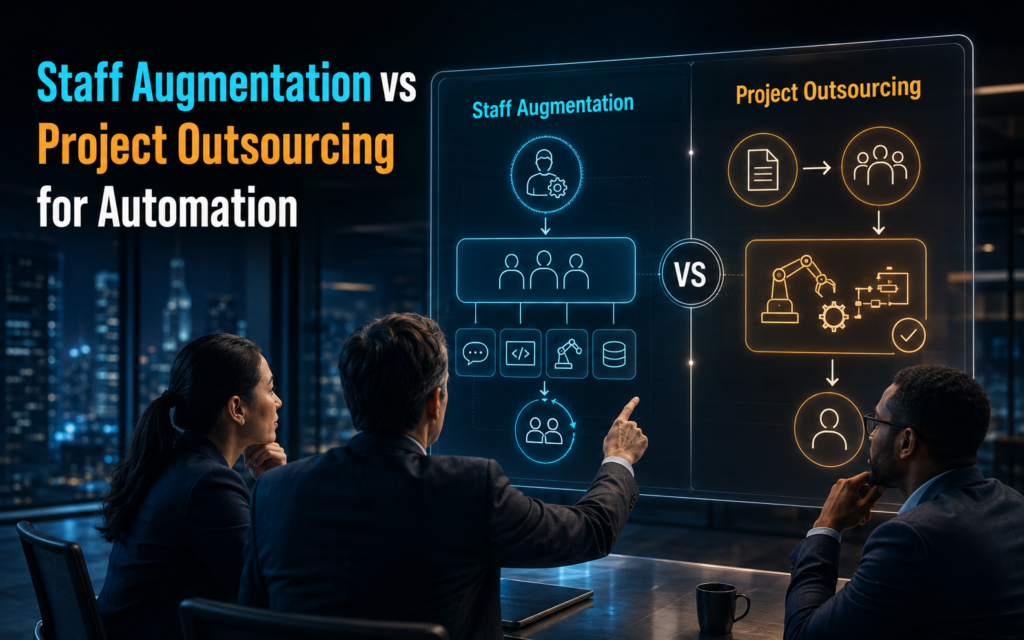
A business that needs support with automation projects must decide how that support will be structured.
Some organisations need a dedicated engineer who can work directly with their internal teams and respond to changing priorities. Others have a clearly defined project and want a provider to manage delivery from beginning to end.
Staff augmentation and project outsourcing can both give an organisation access to technical expertise without immediately building a permanent internal team. The two models differ in how work is managed, how scope is defined, how priorities can change, and who retains responsibility for delivery.
Choosing the wrong model can create unclear responsibilities, unexpected costs, delivery delays, or a solution that does not fit the organisation’s operating requirements.
This article compares staff augmentation and project outsourcing for automation and explains when each model may be appropriate.
What Is Staff Augmentation?
Staff augmentation is an engagement model in which an external engineer or specialist works directly with the organisation’s existing team for an agreed period.
The engineer becomes part of the organisation’s working process and supports its automation priorities. The client directs the work, sets priorities, approves access, and remains responsible for business decisions. The provider manages recruitment, onboarding, and engagement support.
The engineer may work on one major implementation, several department workflows, an automation backlog, or the ongoing maintenance of deployed systems.
This model is useful when the organisation knows it needs technical capacity but expects its priorities or requirements to change during the engagement.
For example, an organisation may begin by automating customer enquiry routing. After the first workflow is deployed, it may decide that CRM updates, reporting, and follow-up notifications should receive greater priority. Under staff augmentation, the engineer can move between approved projects as business needs change.
Organisations considering this structure should understand how AI automation engineer staff augmentation works before deciding whether it suits their internal management capacity and project requirements.
What Is Project Outsourcing?
Project outsourcing is an engagement model in which an external provider takes responsibility for delivering a defined project.
The client provides the project requirements, expected output, timeline, and acceptance criteria. The provider determines how the work will be organised and manages the technical team responsible for delivery.
For an automation project, the provider may conduct discovery, design the workflow, connect the required systems, complete testing, and deliver the agreed solution.
This model works best when the organisation can define what it needs before delivery begins. The scope should state the processes being automated, systems involved, required functions, delivery stages, responsibilities, and final output.
If requirements change after the scope has been approved, the organisation may need to submit a change request. This can affect the timeline, cost, or final deliverables.
Project outsourcing gives the provider greater responsibility for delivery management. It gives the client less direct involvement in the provider’s day-to-day technical work.
Staff Augmentation vs Project Outsourcing
The main difference between the two models is how responsibility and control are divided.
| Factor | Staff augmentation | Project outsourcing |
| Scope | Can change as business priorities change | Defined before delivery begins |
| Work management | The client directs the engineer’s priorities | The provider manages project delivery |
| Team integration | The engineer works directly with the internal team | The provider operates as an external delivery team |
| Control | The client has greater control over daily priorities | The client manages through the approved scope and milestones |
| Flexibility | Suitable for changing or ongoing requirements | Changes may require a revised scope |
| Internal management | Requires active involvement from the client | Requires less daily technical management from the client |
| Duration | Can support short-term or ongoing work | Usually ends when the agreed project is delivered |
| Knowledge transfer | The engineer develops direct knowledge of internal processes | Knowledge is held within the project team and documentation |
| Continuity | Suitable for maintenance and continued improvement | Ongoing support may require a separate agreement |
| Best suited for | Automation backlogs, changing priorities, and ongoing technical support | Clearly defined projects with fixed outputs |
Neither model is automatically better. The right choice depends on the type of work, the organisation’s internal resources, and the level of control and flexibility required.
Scope and Requirements
Scope is one of the most important differences between staff augmentation and project outsourcing.
Under staff augmentation, the organisation can adjust the engineer’s priorities within the engagement. The engineer may move from one workflow to another as projects are completed or business requirements change.
The organisation still needs clear assignments. Flexibility should not result in an engineer receiving several conflicting priorities. Each workflow should have an agreed process owner, expected outcome, access requirements, and delivery sequence.
Under project outsourcing, the scope must be defined before delivery begins. The provider estimates the work, assigns resources, and creates a delivery plan based on the approved requirements.
This structure gives both parties clarity, but it provides less flexibility after the project begins. A change to the workflow, systems, or expected output may require a new estimate and approval.
Project outsourcing may be appropriate when the organisation knows exactly what it needs. Staff augmentation may be more suitable when the organisation has several automation priorities or expects requirements to develop over time.
Control Over Priorities and Delivery
Staff augmentation gives the organisation greater control over the engineer’s daily work.
The internal team decides which workflows should be addressed, provides business context, approves technical access, and reviews progress. This can be valuable when the work affects several departments or depends on frequent feedback from process owners.
Greater control creates greater management responsibility. The organisation must provide direction, resolve questions, make decisions, and prevent conflicting requests from reaching the engineer.
Project outsourcing gives the provider greater control over technical delivery. The client reviews milestones and outputs rather than managing individual tasks.
This can reduce the organisation’s daily management burden. It also means the client must communicate requirements clearly at the beginning. The provider cannot deliver the expected result if the scope does not reflect the actual business process.
Flexibility When Requirements Change
Automation projects often change after discovery begins.
An engineer may find that a required application cannot support a particular action. A department may identify an exception that was missing from the original process map. Security requirements may limit how data can be transferred.
Staff augmentation allows the organisation and engineer to adjust the approach as these issues arise. Priorities, workflow design, and delivery stages can be revised within the available capacity and engagement terms.
Project outsourcing manages changes through the project scope. Minor adjustments may be included, but significant changes may affect the cost and timeline.
This does not make project outsourcing inflexible. It creates a more formal process for controlling changes. That structure can protect the project from continuous expansion, but it may slow decisions when operating requirements change frequently.
Internal Management Responsibilities
Staff augmentation requires the client to provide active management.
The organisation should assign a business owner who can explain the process, approve operating rules, and confirm the expected outcome. It should also provide a technical contact for access, security, and integration questions.
The provider may support onboarding and engagement management, but the client remains responsible for deciding what the engineer should work on.
Project outsourcing shifts more delivery responsibility to the provider. The provider manages the technical team, work allocation, development process, and project schedule.
The client still needs to provide requirements, access, decisions, and approvals. Outsourcing a project does not remove the need for internal ownership. It changes the type of involvement required.
Before selecting a model, leaders should assess whether the organisation has the capacity to manage a dedicated engineer or would prefer to manage the work through milestones and deliverables.
Technical Knowledge and Business Context
Automation engineers need to understand the systems they are connecting and the processes they are changing.
Under staff augmentation, an engineer works closely with internal employees and develops direct knowledge of the organisation’s workflows, systems, data, and priorities. This knowledge can improve over time as the engineer supports more projects.
The relationship may be valuable for organisations building a long-term automation programme. The engineer can apply lessons from one workflow to another and identify dependencies across departments.
Under project outsourcing, the provider gathers the information required to deliver the approved scope. Knowledge is developed within the project team and should be transferred through documentation, training, and handover.
The organisation should confirm what documentation will be provided. This may include workflow logic, system connections, credentials management, testing records, error procedures, known limitations, and maintenance requirements.
A project should not leave the organisation dependent on information held only by the external provider.
Cost and Commercial Structure
The commercial structure differs between the two models.
Staff augmentation is commonly priced according to the engineer’s time, such as an hourly, weekly, or monthly rate. The cost reflects the duration of the engagement and the amount of technical capacity provided.
This structure offers flexibility, but the organisation must manage priorities carefully. Time spent on unclear requirements, delayed approvals, or repeated changes still uses the available engineering capacity.
Project outsourcing may use a fixed project fee, milestone-based payments, or a time-and-materials structure linked to an approved scope.
A fixed price can provide budget certainty when the requirements are stable. If the scope changes, the organisation may incur additional costs.
The lowest initial price should not determine the decision. Leaders should compare the full cost of management, discovery, development, testing, documentation, monitoring, maintenance, and future changes.
Delivery Speed
Staff augmentation can give the organisation faster access to technical capacity when the provider has already assessed and prepared suitable engineers.
The engineer can begin with the organisation’s highest-priority workflow and continue to other projects as requirements are approved.
Delivery speed will still depend on process clarity, system access, data readiness, and the availability of internal decision-makers.
Project outsourcing may require more planning before development begins. The provider must assess the scope, estimate the work, assign the project team, and agree on delivery terms.
This preparation can improve project control. It can also extend the period before technical work begins.
Organisations should avoid comparing the models only by onboarding speed. The more important question is which model can move the work from requirements to a reliable, monitored solution.
Security and Access Control
Both models require clear security and access requirements.
With staff augmentation, the engineer may work across several workflows and systems. The organisation should use role-based permissions and provide only the access required for approved work.
Access should be reviewed as priorities change. An engineer who moves from a recruitment workflow to a finance workflow may require different permissions.
Under project outsourcing, system and data access should be limited to the approved scope. The provider should explain who will access the information, how credentials will be managed, and how access will be removed after delivery.
For both models, the organisation should define confidentiality requirements, activity logging, development and production access, data handling rules, approval procedures, and incident responsibilities.
Security should be addressed before development begins rather than added during final testing.
Testing, Monitoring, and Maintenance
A successful automation project requires more than an initial deployment.
The workflow should be tested against normal transactions, missing data, duplicates, incorrect formats, unavailable systems, expired permissions, and relevant exceptions.
Under staff augmentation, the engineer may continue monitoring and improving the workflow after deployment. This can support faster issue resolution and continued adaptation as the business process changes.
Under project outsourcing, testing and handover should form part of the agreed scope. Ongoing monitoring and maintenance may require a separate support agreement.
The organisation should confirm who will receive failure notifications, resolve technical issues, update documentation, and approve future changes.
A workflow can become unreliable after a connected application, permission, API, or business rule changes. Maintenance responsibilities should be clear regardless of the engagement model selected.
When Staff Augmentation May Be Suitable
Staff augmentation may be appropriate when the organisation has ongoing automation requirements, several workflows to deliver, or priorities that may change.
It may also suit organisations that have internal business and technical leadership but lack enough engineering capacity to complete the work.
Common situations include managing an automation backlog, extending an internal technology team, supporting several departments, improving deployed workflows, and testing the need for a permanent automation function.
The model is most effective when the organisation can provide clear priorities, responsive process owners, timely approvals, and structured access to systems.
When Project Outsourcing May Be Suitable
Project outsourcing may be appropriate when the organisation has a clearly defined automation requirement with agreed outputs, timelines, and acceptance criteria.
It may suit a company that does not want to manage the daily technical work or needs a provider to coordinate several specialists.
Examples include implementing a defined customer onboarding workflow, integrating two specified systems, migrating an existing automation, or delivering a fixed reporting solution.
The model works best when requirements are stable and internal stakeholders can provide timely information, access, feedback, and approval.
Can an Organisation Use Both Models?
Staff augmentation and project outsourcing do not need to be mutually exclusive.
An organisation may outsource a large implementation to a project provider and use an augmented engineer for smaller workflows, internal coordination, monitoring, and continued improvement.
It may also use project outsourcing for a specialised technical requirement while a dedicated engineer manages the broader automation backlog.
Using both models requires clear boundaries. The organisation should define ownership, system access, documentation standards, dependencies, and communication responsibilities.
Without these boundaries, engineers and providers may duplicate work or make conflicting changes to connected systems.
Questions to Ask Before Choosing an Engagement Model
Before making a decision, leaders should review the following questions:
- Is the required output clearly defined?
- Are requirements likely to change during delivery?
- Does the organisation have several automation projects or one fixed project?
- Can internal leaders manage a dedicated engineer?
- How much control does the organisation need over daily priorities?
- What systems and data will the work involve?
- Who will monitor and maintain the workflow after deployment?
- What documentation and knowledge transfer are required?
- How quickly does the organisation need technical capacity?
- Will the work continue after the first workflow is delivered?
The answers should make the most suitable structure clearer.
Organisations should also identify which business processes are suitable for automation before selecting an engagement model. A clearly defined process makes it easier to estimate the skills, time, access, and support required.
How Loubby AI Supports Different Engagement Requirements
Loubby AI provides dedicated AI automation engineers who work directly with organisations to assess processes, develop workflows, connect systems, conduct testing, monitor performance, and maintain deployed automations.
We manage recruitment and onboarding and can provide an engineer within three days. Your engineer can support a defined project, an active automation backlog, or ongoing workflow development based on your engagement requirements.
You can hire an engineer according to your preferred engagement model, project scope, workload, duration, and support requirements. Your organisation retains control of business priorities, process rules, access approval, and operating decisions.
Before the engagement begins, identify the first workflow, appoint a process owner, document the systems involved, and define the expected result. Organisations preparing for this process should assess the required skills and onboarding requirements before selecting an engineer.
Conclusion
Staff augmentation and project outsourcing provide different ways to access automation expertise.
Staff augmentation gives the organisation a dedicated engineer who works directly with its internal team and can respond to changing priorities. Project outsourcing gives a provider responsibility for delivering a defined project according to an approved scope.
The right model depends on the clarity of the requirements, duration of the work, internal management capacity, need for flexibility, security requirements, and plans for monitoring and maintenance.
If your organisation needs a dedicated engineer who can work directly with your team on automation projects, hire an AI automation engineer through Loubby AI to get started.