




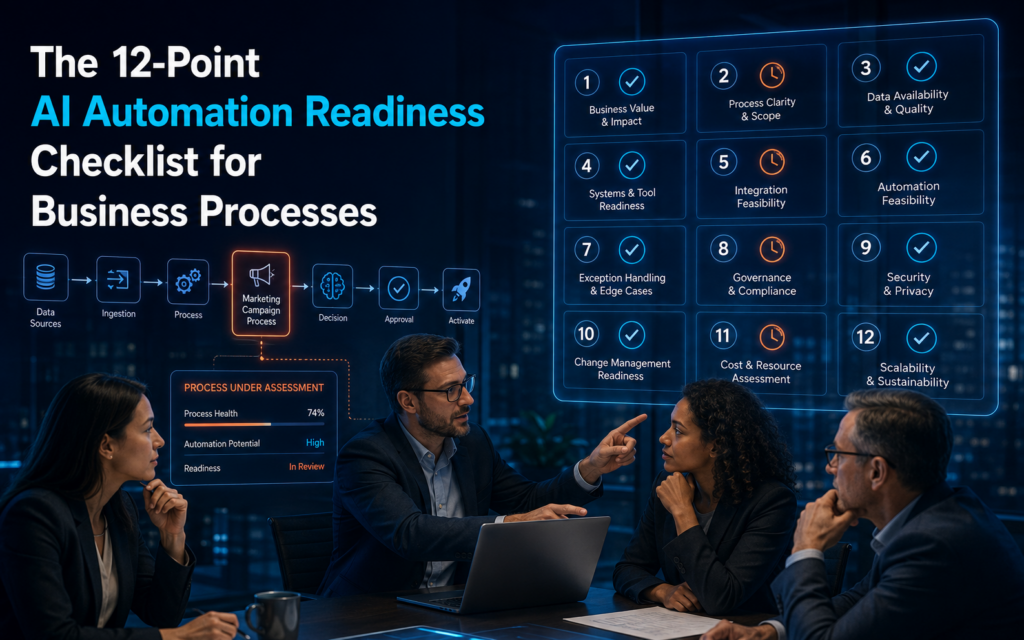
Identifying a business process that could benefit from AI automation is only the beginning. Before development starts, the organisation must determine whether the process, data, systems, people, and controls are ready to support a reliable automated workflow.
A process may appear suitable because it is repetitive, time-consuming, or prone to delays. Development can still stall if the operating rules are unclear, employees follow different procedures, required data is incomplete, or access to connected systems has not been approved.
An AI automation readiness assessment helps the organisation identify these problems before technical work begins. It reduces avoidable delays, improves project planning, and gives the engineer clearer requirements.
This 12-point AI automation readiness checklist explains the main areas an organisation should assess before approving a business process for automation.
What Does AI Automation Readiness Mean?
AI automation readiness describes whether a business process has the structure, information, technology, ownership, and controls required for successful automation development.
A process is ready when the organisation can explain how it currently works, identify who owns it, define the expected result, provide access to the required systems and data, and establish how the workflow will be tested and monitored.
Readiness does not mean that every technical decision has already been made. The engineer may still need to conduct discovery, compare implementation options, and document detailed requirements. It means the organisation has enough clarity to begin without relying on assumptions.
A process that is not yet ready should not automatically be rejected. The assessment should show what must be addressed before development starts.
Why AI Automation Readiness Should Be Assessed Before Development
Starting development too early can create significant rework. An engineer may build a workflow based on one employee’s explanation only to discover that another department follows a different process. A system connection may be designed before the organisation confirms that the required data can be accessed. Testing may begin without anyone authorised to approve the final workflow.
These problems are not necessarily caused by the automation platform or AI model. They often result from incomplete preparation.
Assessing readiness allows business and technical teams to identify missing information, conflicting rules, access restrictions, and process risks before they affect delivery. It also helps leaders compare different requests and determine which projects are prepared to move forward.
Organisations managing several proposed projects can use readiness as part of the process for prioritising an automation backlog. A high-value project may still require further preparation if its process, data, systems, or controls are not ready.
1. Is the Business Problem Clearly Defined?
The organisation should begin by defining the problem that AI automation is expected to address.
A request such as “automate our recruitment process” is too broad. It does not identify the stage causing delays, the employees affected, or the result the organisation expects.
A clearer requirement might state that interview scheduling takes several hours each week, creates repeated communication between recruiters and candidates, and delays the hiring process. This gives the organisation a specific problem to assess.
The problem statement should explain the current operating issue, who it affects, and why it matters. It should also distinguish the business problem from a preferred technical solution.
For example, “we need an AI chatbot” describes a proposed tool. “Customers wait too long for routine enquiries to be classified and assigned” describes the operating problem. Starting with the problem gives the engineer room to recommend an appropriate solution.
2. Is the Process Clearly Documented?
A process should be documented as it operates now, including its trigger, steps, decisions, approvals, exceptions, and expected output.
The documentation does not need to be a complex technical diagram. It should provide enough detail for someone outside the department to follow the process from beginning to end.
Speak with the employees who perform the work rather than relying only on official policies. Actual operations may include manual checks, spreadsheets, email approvals, and workarounds that are missing from formal procedures.
The process map should show where information enters the workflow, how it moves between employees and systems, and what happens when a normal condition is not met.
If the organisation cannot describe the current process consistently, it should document and standardise the work before development begins. Automating an unclear process may reproduce its inefficiencies and make future changes more difficult.
3. Does the Process Follow Consistent Rules?
AI automation requires rules that can be translated into workflow logic.
A rule such as “send purchase requests above $5,000 to the finance director for approval” can be documented and tested. A decision such as “send unusual requests to whoever appears suitable” is too subjective.
Review how employees complete the process. If different employees apply different rules, the organisation must decide which method should become standard.
Not every decision needs to be automated. Processes involving professional judgment, sensitive decisions, or unusual circumstances may retain a human review stage. The workflow can collect the required information, apply standard checks, and route the case to an authorised employee.
The goal is to define where fixed rules apply, where AI can support interpretation or classification, and where human judgment remains necessary.
4. Does the Process Have a Clear Owner?
Every automated process needs a business owner who is accountable for its requirements and results.
The process owner should be able to explain the current workflow, confirm operating rules, answer questions, approve changes, and participate in testing. The owner should also have the authority to resolve disagreements between departments.
Without clear ownership, projects often stall when requirements change or approvals are needed. The engineer may receive conflicting instructions from different stakeholders and have no clear basis for deciding which direction to follow.
Technical ownership must also be established. The technical owner is responsible for designing, building, documenting, monitoring, and maintaining the automation.
In some organisations, these responsibilities may be shared between an internal employee and an external engineer. The important point is that business and technical accountability are both clearly assigned.
5. Is the Current Performance Measurable?
The organisation should record how the process performs before AI automation begins.
The appropriate measures depend on the workflow. A customer service process may be evaluated through response time, routing accuracy, unresolved requests, and employee handling time. A finance process may use processing time, approval delays, error rates, and cost per transaction.
Without baseline information, the organisation cannot determine whether automation improved performance. It may know that the workflow operates, but not whether it reduced delays, errors, or manual effort.
If the process is not currently measured, collect a representative sample over an agreed period. Record transaction volume, completion time, waiting time, employee hours, errors, and repeated work where relevant.
The expected outcome should then be stated in measurable terms. Instead of aiming to “make the process faster,” the organisation may aim to reduce average processing time from two days to four hours.
6. Is the Required Data Accurate and Accessible?
AI automation depends on the quality and availability of the information entering the workflow.
Review where the required data is stored, who owns it, how it is formatted, and how frequently it is updated. Identify missing fields, duplicate records, inconsistent naming, and outdated information.
A workflow built on unreliable data may complete its technical steps correctly while still producing an incorrect result. For example, an automated lead-assignment workflow cannot route enquiries accurately if industry, territory, or company-size information is missing.
The organisation should determine whether data needs to be cleaned, standardised, or collected differently before development begins. Validation rules may also be required to prevent incomplete information from moving through the workflow.
Access should be confirmed before the project is approved for delivery. The organisation must know whether the engineer can use the required data and whether any restrictions apply to its processing or transfer.
7. Can the Required Systems Be Connected?
Most business automations involve more than one application. A workflow may connect a form, spreadsheet, CRM, email platform, database, payment system, or internal application.
Technical readiness depends on whether these systems can exchange information securely and reliably.
The assessment should examine whether APIs, webhooks, exports, built-in integrations, or other connection methods are available. It should also review authentication requirements, transaction limits, permissions, and the reliability of each system.
Legacy applications may have limited connection options. In such cases, the organisation may need a custom integration, an intermediate database, or a revised process.
The availability of a standard connector does not confirm that the workflow is technically ready. The engineer still needs to determine whether the connector supports the required actions, fields, volume, and error handling.
8. Are Security and Access Requirements Defined?
The organisation should define security requirements before the engineer receives access to systems or data.
The access plan should identify which applications the engineer may use, the information they may view, the permissions required, and how credentials will be managed. Development, testing, and production access should be separated where the systems permit it.
Give the engineer only the permissions required to complete the work. Sensitive actions may require approval stages, transaction limits, activity logs, or human review.
The organisation should also examine whether the workflow will process customer information, employee records, financial data, confidential documents, or other protected information.
For AI-assisted workflows, determine what information may be sent to external models or services. The engineer should be able to explain how data will be transmitted, processed, stored, and protected.
Security requirements form part of the workflow design. They should not be added only after development is complete.
9. Are Exceptions and Failure Conditions Understood?
A workflow should not be designed only for normal transactions. The organisation must identify what can go wrong and how the process should respond.
Common exceptions include missing information, duplicate records, incorrect formats, unavailable systems, expired permissions, rejected approvals, and transactions that exceed agreed limits.
The process owner should explain how employees handle these cases now. The engineer can then determine whether the workflow should retry the action, notify an employee, pause for review, or stop the transaction.
Failure handling should include clear ownership. Someone must know when a workflow fails, where the failure is recorded, and who is responsible for resolving it.
A workflow that completes most transactions but leaves errors unnoticed can create more operating risk than the original manual process.
10. Is the Organisation Ready to Test the Workflow?
Testing requires time, data, access, and participation from the people who understand the process.
Before development begins, identify who will provide test cases, review the output, and approve the workflow. Testing should cover normal transactions, missing data, duplicates, system failures, incorrect formats, and relevant exceptions.
If AI is used, the organisation should also test the accuracy, consistency, and suitability of generated output. Human reviewers should confirm whether the results meet the required business standard.
Testing should take place in a controlled environment where possible. The organisation should avoid using live customer, employee, or financial data unless it is necessary and properly protected.
A workflow should not be deployed simply because its main path works. It should demonstrate that it can manage expected exceptions and provide clear information when human attention is required.
11. Is Ongoing Monitoring and Maintenance Planned?
AI automation is not complete when the workflow is deployed.
Connected systems change. Permissions expire. Forms gain new fields. Business rules are revised. APIs are updated. An AI model may also produce different results after a model or configuration change.
A workflow that works correctly today may fail or produce incomplete results after one of these changes.
The organisation should determine who will monitor workflow performance, receive failure notifications, resolve technical issues, and approve improvements.
Monitoring should cover completion rates, failures, processing time, manual intervention, and the business outcome the workflow was created to improve.
Technical documentation should explain the workflow logic, connected systems, permissions, AI components, error handling, known limitations, and maintenance requirements. This reduces dependence on one engineer and helps future technical teams manage the workflow.
12. Is There Sufficient Delivery Capacity?
A process may be ready for AI automation, but the organisation must still have the technical and operational capacity to deliver it.
The engineer needs access to process owners, technical contacts, security stakeholders, and employees who can participate in testing. If these people are unavailable, the project may remain delayed even when the technical requirements are clear.
The organisation should also determine whether its internal engineers have enough capacity to build and maintain the workflow. A permanent hire may suit sustained long-term demand, while a project provider may suit a clearly defined implementation.
When the organisation requires dedicated technical capacity for ongoing or changing requirements, AI automation engineer staff augmentation can provide an engineer who works directly with the internal team while the provider manages recruitment and onboarding.
Organisations preparing to add this capacity should define the initial workflow, required skills, engagement structure, and onboarding requirements before they hire an AI automation engineer.
The 12-Point AI Automation Readiness Checklist
Use the following checklist to complete the final review:
- The business problem is clearly defined.
- The current process is documented.
- The operating rules are consistent.
- A process owner has been appointed.
- Current performance has been measured.
- Required data is accurate and accessible.
- The necessary systems can be connected.
- Security and access requirements are defined.
- Common exceptions and failure conditions are understood.
- Employees are available for testing and approval.
- Monitoring and maintenance responsibilities are assigned.
- Technical delivery capacity is available.
A process does not need to meet every requirement perfectly before discovery begins. Significant gaps should, however, be addressed before the organisation commits to full development.
How to Interpret the Assessment
After completing the checklist, place the process into one of three readiness categories.
Ready for Delivery
The process is clearly defined, has an owner, uses accessible data, and has measurable outcomes. The systems can be connected, security requirements are understood, and employees are available for testing.
The project can move into detailed requirements, workflow design, and delivery planning.
Ready for Discovery
The process has a clear business case, but some requirements remain unresolved. The organisation may need to confirm data quality, integration options, exceptions, security controls, or expected performance.
A discovery phase can address these questions before full development begins.
Not Yet Ready
The process has no clear owner, employees follow conflicting methods, the expected outcome is unclear, or the required data and systems are not available.
The organisation should standardise the process, assign ownership, improve data quality, or resolve access restrictions before approving development.
How Loubby AI Supports AI Automation Readiness and Delivery
Loubby AI provides dedicated AI automation engineers who work directly with organisations to assess processes, define technical requirements, develop workflows, connect systems, conduct testing, monitor performance, and maintain deployed automations.
We manage recruitment and onboarding and can provide an engineer within three days. Your engineer can evaluate the selected workflow, identify readiness gaps, document technical requirements, and recommend an appropriate implementation approach.
You can hire an engineer based on your preferred engagement model, project scope, workload, and support requirements. Your organisation retains control of process rules, priorities, access approval, and business decisions, while the engineer provides dedicated technical capacity.
To begin, identify the process you want to automate, appoint a process owner, document the systems involved, and define the expected outcome. The readiness checklist can then help determine whether the project can move directly into delivery or requires further discovery.
Conclusion
AI automation readiness depends on more than whether a task is repetitive. The process must have clear rules, reliable data, accessible systems, defined ownership, suitable security controls, and an outcome that can be measured.
Assessing these areas before development begins helps the organisation reduce delays, manage risk, and give the engineer clearer requirements.
A process that is not ready should not be forced into development. The organisation should address the specific gaps, confirm ownership, and improve the underlying process before technical work begins.
If your organisation needs technical support to assess, build, and maintain automated workflows, hire an AI automation engineer through Loubby AI to get started.