




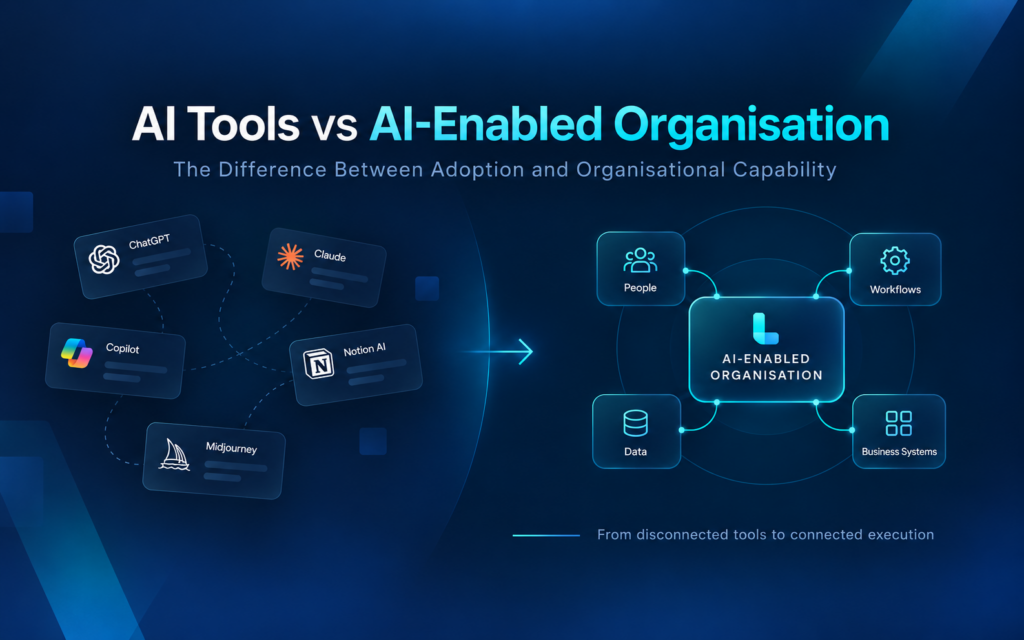
An AI-enabled organisation is not simply one where employees use AI tools. It is one where AI is integrated into workflows, systems, decision-making, and operating processes in ways that change how work is executed across the business.
Many organisations have already adopted generative AI, copilots, automation platforms, and AI assistants. Employees use them to draft documents, analyse information, prepare reports, write code, support customer communication, and complete routine tasks. These tools can improve individual productivity, but adoption at this level does not necessarily change the way the organisation operates.
The difference becomes clear when AI moves beyond individual assistance and into the operating model. An AI-enabled organisation redesigns selected workflows, connects AI to enterprise data and applications, defines decision rights, establishes ownership, introduces appropriate controls, and measures performance against business outcomes.
For leadership teams evaluating AI progress, this distinction is important. Usage metrics such as licenses, active users, pilots, and experiments can show that AI has been adopted, but they do not show whether the organisation has developed the capabilities required to use AI as part of day-to-day execution.
AI Tool Adoption Usually Starts With Individual Productivity
The first stage of AI adoption often focuses on helping employees perform existing tasks more efficiently. A marketing employee may use AI to prepare a draft, a software engineer may use a coding assistant, a finance analyst may summarise a large document, and an executive may use AI to organise research before a meeting.
The employee remains responsible for the wider workflow. AI supports one activity within an existing process, and the person decides how the output should be used, what happens next, and whether any action should follow.
This can create measurable productivity gains without changing the structure of the process itself. Employees may complete individual activities faster, yet the same information still moves manually between systems, the same approvals create delays, and the same teams coordinate work across separate applications.
BCG’s 2026 AI at Work research illustrates this gap. Among frontline employees who regularly use AI, 42% reported saving the equivalent of a workday each week, yet many organisations had not established how that saved capacity should be converted into broader business value.
AI tool adoption can improve how an individual performs a task. Becoming AI-enabled requires the organisation to examine how the complete process should operate.
An AI-Enabled Organisation Changes the Workflow
The shift from AI adoption to AI enablement becomes clearer when the unit of change moves from the employee to the workflow.
A company focused on tool adoption may ask how AI can help an employee write faster, search more efficiently, analyse information more quickly, or prepare documents with less manual effort. An AI-enabled organisation examines the full process and asks how work should be redesigned when AI can retrieve information, interpret context, coordinate systems, prepare decisions, and complete approved actions.
Management reporting provides a useful example. An analyst using generative AI may produce commentary faster after the report has been prepared. The broader reporting process may still require employees to collect information from several applications, reconcile figures, identify anomalies, create charts, obtain approvals, and distribute the final output.
A redesigned reporting workflow could address more of the process. Approved data sources could feed into the workflow automatically, defined checks could identify inconsistencies, analysis could be prepared for review, exceptions could be routed to the appropriate person, and the completed report could move through an established approval process.
The first approach makes one task faster. The second changes how the organisation produces the business outcome.
McKinsey describes a similar progression in its 2026 research on three horizons of AI transformation. The research separates individual AI enablement from workflow-level automation and broader operating-model reinvention, noting that individual productivity gains rarely translate into sustained enterprise value when the surrounding organisation remains unchanged.
Process Redesign Matters More Than Adding AI to Every Task
Introducing AI into an existing process does not automatically improve the end-to-end outcome. A workflow may contain duplicated approvals, repeated data entry, unnecessary handoffs, fragmented information, or long waits between departments. Making one activity faster may have little effect if the main constraint sits elsewhere in the process.
Customer onboarding offers a practical example. A company may use AI to draft welcome emails, yet employees could still collect documents manually, transfer customer data between applications, coordinate account setup across departments, chase approvals, and provide status updates through separate communication channels.
A stronger approach examines the complete onboarding process. The organisation can determine where information should enter the workflow, which checks can be automated, which decisions need human review, which systems need to exchange data, where exceptions occur, and what defines successful completion.
This analysis helps teams determine which business processes are suitable for automation before engineering resources are committed. It can reveal that the highest-value opportunity is not the task that initially attracted attention.
AI-Enabled Organisations Connect AI to Business Systems
General-purpose AI tools often depend on information provided directly by an employee. Their usefulness within an operational process is limited when they cannot access the systems where the relevant business context resides.
Enterprise workflows usually span several applications. A customer-service process may depend on CRM records, billing information, previous support interactions, contracts, product documentation, internal policies, and communication systems. A finance process may require ERP data, invoices, purchase orders, approval records, banking information, and company policies.
AI becomes more operationally useful when it can retrieve approved information from these systems and interact with the applications required to complete the process. This creates engineering requirements around APIs, identity, authentication, data access, permissions, orchestration, error handling, and audit records.
A company can have high employee adoption without building any of these connections. An AI-enabled organisation develops the integration layer required for AI to participate in real business operations rather than remaining separate from them.
Decision Rights Change When AI Can Take Action
Most general-purpose AI tools operate under direct employee supervision. A person requests an output, reviews it, and decides whether to use it. The governance model is relatively straightforward since the person remains responsible for taking the next action.
Operational AI changes this relationship when systems can update records, send communications, trigger workflows, make recommendations, or complete approved actions independently. At that point, the organisation needs explicit decision rights for AI.
A procurement process might allow an AI system to compare supplier information, review purchase requests, and prepare recommendations. Contract approval may remain with an authorised employee. A customer operations system might resolve routine requests independently but route high-value compensation decisions to a manager.
These boundaries need to be reflected in permissions, approval rules, escalation paths, and audit records. The organisation should know which actions AI can perform independently, which can occur within set limits, and which remain under human authority.
The goal is not maximum autonomy. The goal is an operating model in which the level of AI authority matches the business process, the quality of available information, and the consequences of an incorrect action.
Human Oversight Becomes Part of Workflow Design
Human involvement in an AI-enabled organisation extends beyond reviewing generated text. People can occupy clearly defined positions within AI-supported workflows where judgment, context, approval, or accountability is required.
An AI system processing a routine case may complete most of the workflow independently. If required information is missing, a transaction falls outside defined limits, or the system identifies conflicting data, the case can move to an employee with the information needed to make a decision.
This requires more than adding an approval button. The workflow needs to define the conditions that trigger escalation, the person or role responsible for receiving it, the context presented for review, and what happens after the employee makes a decision.
Deloitte’s research on operating models for humans and AI agents examines this shift in organisational design. As AI agents take on more operational responsibilities, leaders need to reconsider how decision points, responsibilities, and management structures are distributed between people and digital systems. (Deloitte)
Human oversight works best when it is part of the process architecture from the beginning. Retrofitting oversight after a system has already been designed for autonomous execution can require substantial changes to permissions, workflow logic, interfaces, and escalation mechanisms.
AI-Enabled Organisations Establish Clear Ownership
AI implementation often cuts across several teams. A business function may own the process, engineering may build the integrations, IT may manage infrastructure, security may control access, and data teams may maintain information sources.
Several teams can participate in an implementation without sharing equal accountability for the result. Each production AI system needs clear business and technical ownership.
The business owner should be accountable for the operational outcome. This includes determining whether the system is improving the process, deciding when business rules need to change, and evaluating whether the implementation still meets organisational requirements.
Technical ownership covers a different set of responsibilities. Someone needs to maintain integrations, investigate failures, monitor performance, manage model or workflow changes, review permissions, and keep the system functioning as technical dependencies change.
Without defined ownership, organisations can accumulate AI systems that remain technically available but gradually become disconnected from current business processes. Problems can sit between functions when each team assumes another team is responsible for resolving them.
AI Enablement Requires Ongoing Engineering
AI tool adoption can happen quickly. An employee can gain access to a software application and begin using it with limited technical work from the organisation.
Operational AI systems have a longer lifecycle. APIs change, models are updated, business policies evolve, data structures change, new edge cases emerge, and users interact with systems in ways that may not have appeared during testing.
Maintenance is part of the implementation model rather than a separate consideration after launch. Teams need to review failures, evaluate output quality, update integrations, change workflow logic, test new models, manage permissions, monitor costs, and respond to changes in the business process.
An AI automation readiness assessment can identify gaps in ownership, system access, data quality, exception handling, and process definition before development begins. Addressing these issues early gives the engineering team a stronger foundation for production implementation.
Companies moving from experimentation to operational AI need to plan for engineering capacity across the full lifecycle of the system rather than budgeting only for the initial build.
Governance Moves From Policy to System Design
Early AI governance often focuses on usage policies. Organisations establish approved tools, define restrictions around confidential information, provide employee guidance, and set general expectations for responsible use.
These controls remain useful, but operational AI requires governance to become part of the workflow itself.
If company policy requires employee approval for transactions above a defined amount, the technical workflow needs a mechanism that prevents the AI system from completing those transactions independently. If access to sensitive employee information is restricted, the system’s permissions need to enforce that rule.
Traceability requires similar engineering. If an organisation needs to know what information an AI system used, which action it performed, who approved an exception, and what happened afterward, those events need to be recorded as part of the workflow.
This makes governance a technical and operational responsibility as much as a policy responsibility. Business leaders need to define the required controls clearly, and engineering teams need to translate those requirements into system behaviour.
AI Capability Becomes Reusable Across the Organisation
Tool-based adoption can develop department by department. Marketing selects one application, finance experiments with another, HR introduces a separate assistant, and operations creates its own automation. Each team may gain value, yet the organisation can accumulate duplicated tools, integrations, governance approaches, and technical infrastructure.
An AI-enabled organisation begins to develop capabilities that can support several use cases. Common authentication patterns, permission structures, integration layers, knowledge systems, evaluation methods, monitoring infrastructure, approval mechanisms, and audit frameworks can be reused across departments.
A knowledge architecture developed for customer support may later serve sales and operations. An approval mechanism built for finance may provide a pattern for procurement. Monitoring infrastructure created for one AI workflow may be extended to several production systems.
The value of an AI implementation then extends beyond the immediate use case. Each project can contribute technical and operational components that reduce the cost and effort required to build future systems.
This is one of the differences between accumulating AI applications and developing enterprise AI capability.
Roles Begin to Change When AI Owns More of the Workflow
General-purpose AI tools often change how employees perform individual tasks without significantly changing their job responsibilities. An employee may write faster or complete research more efficiently, yet the overall role remains familiar.
Deeper AI integration can alter the composition of the role. If AI systems can collect information, perform routine analysis, prepare documentation, monitor processes, and coordinate standard activities, employees may spend more time handling exceptions, exercising judgment, managing relationships, interpreting unusual situations, and improving the systems supporting their work.
Managers may face a similar change. Their responsibilities can expand from managing employees to overseeing a combination of employees, automated workflows, and AI agents operating across the same business process.
This does not mean every role requires redesign as soon as an AI tool is introduced. Role design becomes relevant when AI takes responsibility for a meaningful part of the workflow rather than simply assisting an employee with isolated activities.
BCG’s 2026 survey found that 67% of respondents said AI had taken over simpler tasks, leaving them with more complex work, and 72% reported changes in the skills expected of them. These findings suggest that the organisational effects of AI extend beyond productivity once adoption becomes widespread.
Measurement Needs to Move Beyond Adoption Metrics
AI tool adoption is relatively straightforward to measure. Organisations can track licenses, active users, usage frequency, training completion, prompts, or the number of AI applications deployed.
These measures show whether employees have access to AI and whether they are using it. They provide less information about whether business performance has changed.
An AI-enabled organisation connects measurement to the purpose of the process being redesigned. Depending on the use case, useful metrics may include cycle time, cost per transaction, processing capacity, error rates, customer resolution time, escalation frequency, conversion rates, revenue contribution, or operational risk.
A customer-service implementation might be evaluated through resolution rates, response time, escalation rates, and customer outcomes. An accounts-payable workflow could focus on processing cost, exception frequency, cycle time, and payment accuracy.
This moves the AI conversation from adoption to business performance. BCG’s 2026 research makes the same distinction, recommending that organisations measure value rather than treating usage as the primary indicator of progress.
Tool Adoption Still Has a Role in Enterprise AI
Moving toward an AI-enabled operating model does not require companies to stop providing employees with general-purpose AI tools. Individual adoption can create useful productivity gains, build familiarity with AI, and help employees identify repetitive work that may later become suitable for structured automation.
The distinction lies in the objective. General-purpose tools support employees inside existing processes, whereas deeper implementation redesigns selected processes when there is a clear business case for doing so. Organisations can use both approaches at the same time, with each serving a different type of need.
Not every task requires a production AI workflow. Enterprise implementation should focus engineering investment on processes where integration, automation, or process redesign can create measurable operational value.
As potential initiatives accumulate, teams need a consistent method for prioritising an automation backlog based on business value, feasibility, readiness, risk, and implementation effort. This helps separate opportunities that justify deeper engineering from those that can remain individual productivity use cases.
How to Assess Whether an Organisation Is Becoming AI-Enabled
Leadership teams can evaluate progress by looking beyond the number of AI tools in use and examining how AI is changing the organisation’s operating capability.
Workflow Design
Teams should examine whether AI is being added to individual tasks or whether selected processes are being redesigned from end to end. A redesigned workflow should have a clear business outcome and defined responsibilities across people, AI systems, and existing software.
System Integration
The organisation should assess whether AI operates mainly as a standalone assistant or has controlled access to the business applications and data required to perform operational work. Integration should reflect the needs and risk level of each process.
Decision Rights
Teams need to know which actions AI can complete independently, which operate within defined boundaries, and which require human approval. These rules should be implemented through the workflow rather than left as informal expectations.
Ownership
Each production system should have clear business and technical ownership. Responsibility should continue after launch through monitoring, maintenance, performance review, and ongoing improvement.
Governance
Governance should be reflected in permissions, access controls, approval mechanisms, escalation processes, audit records, and monitoring. Policies provide direction, but system design determines how those requirements operate in practice.
Measurement
Performance should be connected to business outcomes rather than AI usage alone. Teams should be able to explain which operational metric the implementation is intended to change and whether that change is occurring.
Reusable Capability
Organisations should examine whether each implementation creates components, patterns, or knowledge that can support future projects. Reuse is a sign that AI implementation is becoming an organisational capability rather than a sequence of disconnected experiments.
These areas provide a more useful view of AI maturity than adoption numbers alone. An organisation may be advanced in one area and still have significant work to do in another, which gives leadership a clearer basis for deciding where the next investment should go.
From AI Adoption to Organisational Capability
Providing employees with AI tools can create useful productivity gains, but becoming an AI-enabled organisation requires broader changes to how selected work is designed and managed. AI needs to connect with business processes, enterprise systems, decision structures, ownership models, governance controls, and measurable operational outcomes before it can become a dependable part of day-to-day execution.
The transition does not require redesigning the entire organisation at once. Companies can begin with a small number of high-value processes, build the technical and operational capabilities needed to support them, and reuse those capabilities across subsequent implementations. This creates a more disciplined path from employee-level AI use to enterprise-wide operational capability.
For organisations that have identified valuable AI opportunities but lack the internal engineering capacity to move them into production, an embedded AI engineering model can provide dedicated technical support while keeping implementation closely connected to the teams that own the underlying processes.