





An automation backlog often begins with a few reasonable requests. Sales wants leads transferred into the CRM. Finance wants invoices routed for approval. Recruitment wants interview scheduling automated. Operations wants recurring reports prepared without manual consolidation.
As more departments identify opportunities, the list grows faster than the organisation can deliver. High-value projects become mixed with minor improvements, unclear requests, and technically difficult ideas. Without a consistent way to compare them, the loudest request or most senior stakeholder may determine what gets built next.
An effective automation backlog should help the organisation make deliberate investment decisions. It should show which processes could create the most value, which are technically ready, which carry significant risk, and which require further discovery.
This guide explains how to organise an automation backlog, evaluate each request, and create a delivery sequence based on business value, feasibility, risk, and available engineering capacity.
What Is an Automation Backlog?
An automation backlog is a central record of business processes, tasks, and workflows proposed for automation. It may include new requests, approved projects awaiting delivery, existing automations requiring improvement, and ideas that need further assessment.
A backlog is more than a list of departments and tasks. Each entry should contain enough information for business and technical leaders to understand the problem, expected outcome, systems involved, operating risk, and likely delivery effort.
For example, “automate customer service” is too broad to evaluate. It may include enquiry classification, request routing, acknowledgement messages, case escalation, knowledge retrieval, and performance reporting. Each of these workflows has different requirements and should be assessed separately.
A well-managed backlog gives leaders a complete view of demand and prevents automation decisions from being made in isolation. It also helps the organisation align limited technical capacity with the processes that have the strongest case for investment.
Why Automation Backlogs Continue to Grow
Automation demand often grows as employees recognise how much time is spent on repeated administrative work. The problem is rarely a shortage of ideas. The difficulty is turning those ideas into clearly defined and deliverable projects.
Some requests remain in the backlog because the expected outcome has not been defined. Others depend on data that is incomplete or systems that cannot be connected easily. Internal technology teams may already be committed to core infrastructure, security, customer products, and system maintenance. Department-level automations then compete with work carrying greater operational risk.
Priorities may also change when a new leader, customer requirement, or urgent operating issue appears. If the organisation has no scoring method, previously approved projects can be displaced without a clear decision process.
An expanding backlog is not automatically a problem. It can show that teams are identifying opportunities for improvement. It becomes a problem when the organisation cannot distinguish high-value work from low-impact requests, or when approved projects remain delayed because no one owns delivery.
Build a Complete and Consistent Backlog
Before prioritising projects, bring all automation requests into one central record.
Each entry should explain the current process, the operating problem, the expected result, the process owner, and the systems involved. It should record how frequently the process occurs, how much employee time it consumes, and where errors or delays happen. The entry should also identify relevant data, access requirements, dependencies, and any known security or regulatory concerns.
Using a standard intake form makes requests easier to review and reduces the time spent returning to departments for basic information. The form should be completed with the process owner and employees who perform the work. They can explain informal steps, exceptions, and workarounds that may not appear in official procedures.
Large requests should be divided into smaller workflows. “Automate recruitment,” for example, may contain job creation, application screening, interview scheduling, candidate communication, assessment, and onboarding. Dividing the request makes it possible to deliver useful improvements without waiting for an entire department-wide programme.
An organisation that has not yet created a reliable backlog can begin by identifying which business processes are suitable for automation based on their frequency, rules, data quality, risk, and expected outcome.
Remove Requests That Are Not Ready for Prioritisation
Every idea does not need to enter the scoring process immediately. Some requests require further definition before leaders can compare them fairly.
A request should remain in discovery if it has no process owner, no agreed business problem, or no measurable outcome. The same applies when employees follow conflicting procedures, the required data is unreliable, or the systems involved have not been identified.
Removing an item from active prioritisation does not mean rejecting it permanently. It means the request needs more preparation. The process owner may need to standardise the workflow, improve data collection, clarify approval rules, or complete a security review.
This distinction protects the backlog from being dominated by incomplete ideas. It also prevents engineers from starting projects that are likely to stall during development.
Establish the Current Performance of Each Process
The organisation needs a baseline before it can estimate the value of automation. Without current performance data, claims about saving time, reducing cost, or improving service remain difficult to verify.
The baseline should reflect the problem the organisation wants to solve. A reporting workflow may be assessed through the hours spent collecting and consolidating data. A customer enquiry process may be assessed through response time, routing accuracy, unresolved requests, and employee handling time. An invoice process may require data on processing time, error rate, approval delays, and cost per transaction.
Use actual operating information where it is available. If the process is not currently measured, collect a representative sample over an agreed period. Estimates can support an initial review, but high-priority investment decisions should be based on stronger evidence where possible.
Recording the baseline also creates the foundation for evaluating the workflow after deployment. The organisation can compare performance before and after automation rather than relying on whether the new workflow appears faster.
Score Automation Opportunities Using Consistent Criteria
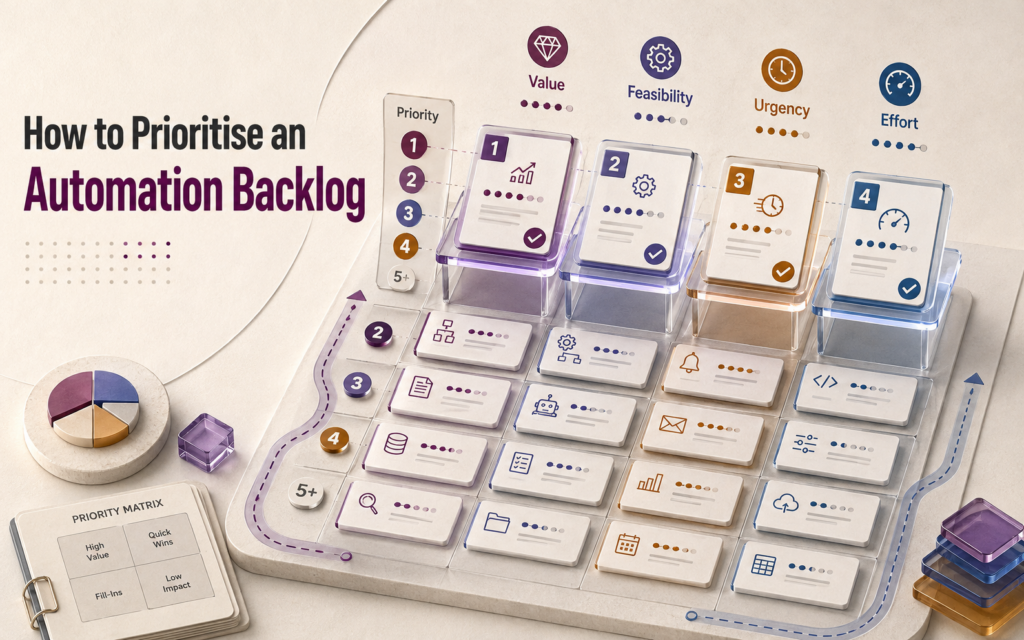
A scoring model gives business and technical stakeholders a shared basis for comparing requests. A simple one-to-five scale is often sufficient. The organisation can adjust the weight assigned to each criterion based on its priorities.
| Criterion | What to assess |
| Business value | The expected effect on cost, revenue, service, compliance, or operating performance |
| Process volume | How frequently the process runs and how many transactions it handles |
| Time savings | The employee time that could be removed from repetitive work |
| Error reduction | The opportunity to reduce missing data, duplicate work, or rework |
| Technical feasibility | Whether the systems, data, and rules support implementation |
| Data readiness | Whether the required information is accurate, complete, and accessible |
| Risk | The impact of failure, incorrect output, or unauthorised access |
| Delivery effort | The time, skills, dependencies, and testing required |
The scoring method should be documented so departments understand how decisions are made. A high score may indicate that a project should receive greater priority, but the final decision should not be based on the total score alone.
A technically simple project may score well but affect only a small number of transactions. A more complex project may require greater effort but address a significant operational constraint. Leaders should consider both the score and the business context behind it.
Balance Business Value With Technical Feasibility
Business value and technical feasibility should be considered together. Prioritising only by potential value can place technically unprepared projects at the front of the backlog. Prioritising only by ease of delivery can produce many small automations without addressing important operating problems.
A high-value project with strong technical feasibility may be prioritised for delivery. A high-value project with low technical readiness may first enter a discovery phase to address data, integration, or security requirements. A lower-value project may still be approved if it can be completed quickly without delaying more important work.
Technical feasibility should cover more than whether an automation platform has a connector for the required application. The assessment should examine APIs, authentication, permissions, data quality, workflow volume, exception handling, testing, monitoring, and maintenance.
The organisation should also confirm whether the process changes frequently. A workflow built around unstable rules may require repeated technical updates and create more maintenance work than expected.
Separate Quick Wins From Strategic Projects
Quick wins and strategic projects serve different purposes and should not compete as though they are identical.
Quick wins usually have clear rules, accessible data, manageable risk, and limited dependencies. They can demonstrate progress, remove visible administrative work, and help the organisation establish delivery practices.
Strategic projects have a broader effect on revenue, cost, customer experience, compliance, or cross-department operations. They may require more discovery, stronger governance, several integrations, and a longer implementation period.
A balanced delivery plan can include both. One portion of engineering capacity can address smaller operational improvements, while another supports high-value projects that need structured discovery and phased delivery.
This prevents the organisation from spending all available capacity on minor requests while major operating problems remain unresolved. It also avoids placing every resource into one complex project with no visible progress for several months.
Review Risk Before Approving a Project
Automation risk depends on the action being performed, the data involved, and the consequences of failure. A workflow that sends an internal reminder has a different risk profile from one that approves a payment, changes a customer account, or processes confidential employee information.
The risk review should examine data sensitivity, financial exposure, customer impact, regulatory requirements, approval authority, audit records, and reversibility. High-risk processes may still be suitable for automation, but they need stronger controls.
Those controls may include restricted permissions, approval stages, test environments, activity logs, transaction limits, human review, and documented incident procedures. The cost and delivery effort associated with these controls should form part of the prioritisation decision.
A project should not receive a high priority solely because the existing process is slow. Leaders must determine whether the organisation can automate it safely and maintain accountability after deployment.
Confirm Ownership Before Delivery Begins
Every automation project needs a business owner and a technical owner.
The business owner defines the operating requirements, explains exceptions, approves process rules, and remains accountable for the outcome. The technical owner designs, builds, tests, documents, monitors, and maintains the workflow.
Projects without clear ownership often stall when questions arise or approvals are delayed. They may also fail after deployment if no one monitors performance or responds when a connected system changes.
Ownership should be confirmed before an item moves from the backlog into active delivery. The organisation should also identify employees who will participate in testing and provide feedback before the workflow is approved for production.
Match the Backlog With Available Delivery Capacity
Prioritisation will not reduce the backlog if the organisation lacks the technical capacity to deliver approved projects. Leaders need a realistic view of the engineers, automation specialists, process owners, and security stakeholders available.
Internal engineers may be able to support automation if their existing responsibilities allow it. A permanent hire may be appropriate when the organisation has consistent long-term demand and wants to build an internal automation function. A project provider may suit a clearly defined implementation.
When requirements are ongoing or likely to change, AI automation engineer staff augmentation can provide dedicated technical capacity without requiring the organisation to create a permanent position immediately.
The selected engagement model should reflect the volume and duration of work, internal management capacity, security requirements, urgency, and need for flexibility. Organisations comparing candidates or engagement options should begin with a clearly defined workflow and assess the skills required from an AI automation engineer.
Create a Clear Delivery Sequence
Once the backlog has been assessed, group projects according to their next action. Some will be ready for delivery. Others will need discovery, process standardisation, data preparation, security review, or executive approval. Low-value requests may be deferred or removed.
The delivery sequence should reflect dependencies. A workflow that depends on a new database, revised process, or system integration cannot begin until that foundation is ready. Making these dependencies visible prevents unrealistic delivery dates.
Avoid activating too many projects at once. Work in progress should match the available delivery capacity. Completing a smaller number of workflows is more valuable than starting several projects that remain unfinished.
Each active project should have an agreed outcome, owner, scope, delivery stages, testing plan, and monitoring requirements. The backlog should show its current status so stakeholders can see whether it is in discovery, approved, in development, testing, deployed, or under review.
Review the Backlog Regularly
An automation backlog should change as business priorities, systems, risks, and available capacity change. A request that was low priority three months ago may become more important after transaction volume increases or a customer requirement changes.
Set a regular review involving operations, technical leaders, security stakeholders, and relevant department owners. The meeting should assess new requests, confirm scores, review project dependencies, and examine the performance of deployed workflows.
Completed automations should not disappear from oversight immediately. Monitoring may reveal new exceptions, adoption issues, or changes in a connected system. These improvements can return to the backlog with evidence from actual use.
Requests with no owner, no measurable outcome, or no progress in discovery should be challenged. Keeping inactive ideas indefinitely makes the backlog less useful and obscures genuine demand.
How Loubby AI Supports Automation Delivery
Loubby AI provides dedicated AI automation engineers who work directly with organisations to assess processes, develop workflows, connect systems, conduct testing, monitor performance, and maintain deployed automations.
We manage recruitment and onboarding and can provide an engineer within three business days. Your engineer can work through approved backlog items, document technical requirements, build and integrate workflows, resolve issues, and support continued improvement.
You can hire an engineer based on your preferred engagement model, backlog size, project scope, workload, and support requirements. Your organisation retains control of priorities, process rules, access approval, and business decisions, while the engineer provides dedicated delivery capacity.
To begin, identify the highest-priority workflow, confirm the process owner, document the systems involved, and define the expected result. This gives the engineer a clear first assignment and creates a basis for measuring progress.
Conclusion
An automation backlog should help an organisation decide where its technical capacity will create the greatest business value. That requires more than arranging requests by submission date or stakeholder seniority.
Build one central backlog, define each request, record current performance, and assess value, feasibility, risk, and delivery effort. Separate quick wins from strategic projects, confirm ownership, and match approved work with realistic engineering capacity.
A structured approach allows the organisation to move suitable projects into production while giving unprepared requests the discovery and process improvement they need.
If your organisation needs dedicated technical capacity to move priority projects from the backlog into working, monitored workflows, hire an AI automation engineer through Loubby AI to get started.