





Many organisations have reached a point where AI is already part of the strategic agenda. Leadership teams are exploring opportunities to reduce manual work, improve decision-making, increase operational capacity, strengthen customer service, or create new ways of working across the business. Some have already invested in generative AI tools, automation platforms, internal assistants, AI agents, or proof-of-concept applications.
The more difficult challenge is moving from strategic intent to operational capability. Identifying where AI might create value is different from building systems that can perform reliably within day-to-day operations. That transition requires organisations to make decisions about business processes, ownership, data access, system integration, governance, human oversight, deployment, monitoring, and long-term maintenance.
This is the focus of enterprise AI execution. It is the discipline of converting AI priorities into working systems that support business operations and can be improved over time.
AI Strategy and AI Execution Serve Different Purposes
An enterprise AI strategy provides direction. It can define where the organisation intends to use AI, which outcomes matter most, how investment should be prioritised, what risks need to be controlled, and how AI fits within broader business objectives.
Execution deals with a different set of questions. Teams need to determine which processes should be addressed first, what role AI should play in each workflow, which decisions require human involvement, which systems need to be connected, how failures should be handled, and who will remain responsible for the system after deployment.
These questions cannot be answered through strategy documents alone. They require operational and technical decisions that connect business goals with the way work is actually performed.
This is one reason the number of AI pilots running across an organisation provides limited insight into AI maturity. A stronger measure is the organisation’s ability to move selected initiatives into production, integrate them with existing processes, maintain their performance, and use the lessons from one implementation to improve the next.
AI Strategy Should Begin With Operating-Model Design
Enterprise AI initiatives often begin with technology selection. Teams compare models, automation tools, agent frameworks, copilots, APIs, and software products before defining how AI should operate within the business.
A stronger approach starts with the operating model. An operating model defines how work moves through the organisation, who owns each stage of a process, which systems support it, where decisions are made, how exceptions are handled, and how accountability is assigned.
Introducing AI changes parts of this structure. For example, adding an AI agent to a customer operations process creates questions about what the agent can do independently, which actions require approval, what customer information it can access, how uncertain cases should be escalated, and who reviews its performance.
These are not software-selection questions. They are operating-model decisions that should be made before technical architecture is finalised.
Selecting technology first can leave an organisation with a capable tool that does not fit the workflow, risk model, approval structure, or responsibilities of the people expected to use it. Operating-model design provides the context required to select the right architecture and technology later in the implementation process.
Define the Business Outcome Before Designing the AI System
AI initiatives are difficult to evaluate when their objective is framed as “use AI in operations” or “deploy AI agents.” These statements describe technology activity rather than the business result the organisation expects to achieve.
A better starting point is a defined operational outcome. A company might want to reduce the time required to prepare management reports, shorten customer onboarding, reduce manual invoice review, increase the percentage of customer requests resolved without internal handoffs, or improve response times for qualified sales opportunities.
Once the desired result has been established, teams can examine the business process responsible for producing it. This often reveals that a problem involves several connected activities rather than one isolated task.
For example, a weekly reporting process may require employees to extract information from multiple applications, check the quality of the data, apply business rules, prepare commentary, request approval, and distribute the completed report. Automating only the report-writing stage may save some time without addressing the broader process that creates the delay.
For this reason, enterprise AI execution should focus on processes and outcomes rather than isolated AI features. A structured review of which business processes are suitable for automation can help organisations identify where AI is most likely to create measurable operational value.
Assess Process Readiness Before Implementation
A business process can have significant automation potential and still be unprepared for AI implementation. The process may rely on inconsistent data, undocumented decision rules, fragmented systems, unclear ownership, or exceptions that experienced employees handle informally.
Implementing AI without addressing these conditions can transfer existing operational weaknesses into the new system. A readiness assessment should examine the process itself, the information required to complete it, the decisions involved, and the people responsible for its performance.
Process Clarity
The current workflow should be sufficiently documented to show where it starts, which systems it touches, what information is required, where decisions are made, how exceptions are handled, and what successful completion looks like.
This does not mean every process needs perfect documentation before implementation begins. It does mean the delivery team should have enough visibility into the workflow to identify where AI can be introduced without creating new operational problems.
Data Availability
An AI system needs access to the information required to perform its role. That information may be distributed across CRM platforms, internal databases, spreadsheets, documents, communication tools, ERP systems, or external applications.
The delivery team needs to confirm that the required data is available, accurate enough for the intended use, and accessible within the organisation’s security and permission requirements.
Decision Boundaries
Teams should define which decisions AI can make independently and which require human judgment or approval. The level of autonomy can vary within the same workflow based on the financial, operational, legal, or reputational risk associated with an action.
For example, an AI system may be permitted to classify routine customer requests automatically but required to escalate a high-value refund or contractual issue to a person.
Ownership
Every production AI system needs a clearly accountable owner. This role should be responsible for system performance, exception handling, business rules, workflow changes, and the business outcome the system is expected to support. A structured AI automation readiness assessment can help organisations identify gaps in ownership, process clarity, data, and implementation readiness before development begins.
Prioritise AI Initiatives as a Portfolio
AI opportunities can accumulate quickly once teams begin reviewing business processes. Finance may identify reporting and reconciliation use cases, operations may focus on workflow automation, customer service may explore AI-assisted support, HR may consider employee-service automation, and commercial teams may identify opportunities across research and account management.
Attempting to pursue every opportunity at the same time can create fragmented projects, competing demands for technical resources, and a growing number of systems without consistent standards.
A portfolio approach allows leadership teams to evaluate initiatives against common criteria such as business value, implementation feasibility, process readiness, risk, time to operational value, and the potential to reuse technical components across future projects. This turns prioritisation into an investment decision rather than a simple ranking of AI ideas.
The strongest projects are not always those with the highest immediate return. An initiative with slightly lower short-term value may still be worth prioritising if it creates reusable authentication, approval, integration, or monitoring capabilities that can support future implementations. When several initiatives are competing for resources, a structured method for prioritising an automation backlog can help teams compare value, feasibility, risk, and implementation effort more consistently.
Define Responsibilities Between People and AI Systems
Production AI requires clear responsibility boundaries between people and automated systems. The objective should not be to give every AI system the maximum possible level of autonomy. The appropriate level depends on the workflow, quality of available information, reversibility of actions, business risk, and consequences of failure.
Low-risk activities with clear completion criteria may be suitable for independent execution. Examples can include retrieving information, preparing internal summaries, classifying requests, updating approved database fields, or generating routine reports.
Other workflows may allow AI to act within defined controls. A system might be authorised to send communications only to approved recipients, update records within specified parameters, or process transactions below a financial threshold.
Higher-risk actions can remain subject to human approval. These may include significant financial commitments, contractual actions, sensitive employee decisions, high-value customer exceptions, or changes that could materially affect the business.
Defining these responsibilities during workflow design makes it easier to build the required approval logic, access controls, escalation paths, and audit records into the system from the beginning.
Build AI Around the Existing Business Environment
Enterprise AI systems rarely operate as standalone applications. A useful implementation often needs to interact with several parts of the organisation’s existing technology environment.
A customer operations workflow, for example, might receive a request through email, retrieve customer history from a CRM, access account details from an internal database, apply business rules, prepare a response, request approval through a communication platform, update the CRM, and record the completed action.
The model handling reasoning or generation is only one component of that workflow. The broader implementation may require API integration, authentication, permissions, data transformation, workflow orchestration, error handling, application logic, monitoring, approval mechanisms, and audit logging.
This is why organisations do not necessarily need to replace their existing software before adopting AI. In many cases, AI can be introduced as an intelligence and automation layer that connects the systems employees already use.
The quality of those integrations has a direct effect on whether the AI system can operate reliably within the business.
Move From Prototype Validation to Production Engineering
A proof of concept is useful for determining whether an idea is technically possible. Production deployment requires a broader standard.
A production system needs to work consistently with real company data, handle incomplete information, interact with existing applications, respect access controls, identify failures, support human intervention, record relevant actions, and continue operating when a dependent service becomes unavailable.
The system should also be maintainable. Teams need a way to change models, adjust workflow logic, update business rules, replace integrations, and respond to new requirements without rebuilding the entire solution.
These requirements explain why a successful demonstration does not automatically translate into a successful production system. Production AI requires engineering around the model, including testing, integration, exception handling, monitoring, fallback behaviour, permissions, and operational controls.
The transition from prototype to production should be treated as an engineering phase with its own standards, rather than as the final step of experimentation.
Establish Ownership After Deployment
Deployment is one stage in the lifecycle of an enterprise AI system. Once the system is active, business conditions and technical dependencies continue to change.
Applications are updated, APIs change, new exceptions appear, company policies evolve, customer behaviour shifts, models are replaced, and employees may begin using the workflow in ways that were not anticipated during testing.
Production systems need ongoing technical and business ownership. That work can include reviewing failures, assessing unusual cases, monitoring output quality, updating business rules, maintaining integrations, adjusting workflow logic, tracking business performance, and extending the system into related processes.
Without clear ownership, AI systems can remain technically active while their usefulness declines over time. The organisation may then accumulate a collection of deployed tools that no longer reflect current processes or priorities.
Long-term ownership should therefore be defined during implementation rather than after deployment.
Build Reusable Capability From Each AI Implementation
A mature enterprise AI program should create more than a series of independent projects. Each implementation can contribute components, standards, and operating practices that reduce the effort required for future work.
A customer operations implementation might establish reusable authentication and permission patterns. A finance workflow might produce a standard approval framework. An internal knowledge application could establish the organisation’s retrieval architecture. A reporting automation may create logging and monitoring standards that other teams can adopt.
Over time, these components become part of the organisation’s AI delivery infrastructure. Future projects can start with existing patterns rather than rebuilding basic capabilities for every use case.
This is an important shift in enterprise AI execution. The organisation begins to move from project-based experimentation to a repeatable implementation capability.
That capability can include technical architecture, governance standards, evaluation methods, integration patterns, workflow components, documentation, and people who understand how to move AI systems into production.
The Role of Embedded AI Engineering
Some organisations reach a point where identifying worthwhile AI opportunities is no longer the main challenge. The constraint shifts to implementation capacity, especially when internal engineering teams are already focused on product development, infrastructure, security, data systems, and other core priorities.
Business teams may understand their workflows in detail but lack the technical capacity to design, integrate, deploy, and maintain AI systems. An embedded engineering model can help close this gap by placing technical talent closer to the teams that own the process and understand the operational requirements.
Embedded AI engineers can examine existing workflows, identify implementation constraints, design integrations, build automation, test systems with users, deploy solutions, and remain involved as those systems move into day-to-day operations. This model can be useful for companies that need dedicated implementation capacity without building a separate internal AI function from the beginning.
The value of embedded AI engineers is strongest when technical execution needs to stay closely connected to the business process being improved. Companies that need additional engineering capacity can also evaluate AI automation engineer staff augmentation as a delivery model for extending internal teams while retaining continuity across implementation and maintenance.
A Seven-Stage Framework for Enterprise AI Execution
A practical enterprise AI execution model can be organised into seven connected stages. Each stage addresses a different part of the transition from strategic priority to operational capability.
1. Define the Business Outcome
The process should begin with the business result the organisation wants to change. This provides a clear basis for evaluating whether AI is the right approach and for measuring performance after implementation.
2. Map the Existing Process
Teams should document the systems, decisions, data, handoffs, owners, exceptions, and operational constraints involved in the current workflow. This provides the context required for system design.
3. Assess Readiness
The organisation should determine whether the process, data, integrations, access controls, and ownership structure can support implementation. Gaps identified at this stage can be addressed before they become technical problems.
4. Design the Operating Model
The implementation team should define what the AI system will own, what people will continue to own, where approvals are required, what permissions the system will receive, and how exceptions will be escalated.
5. Build and Integrate
The AI capability should then be connected to the data, applications, business rules, controls, and workflows required for operational use.
6. Validate Under Real Operating Conditions
Testing should include normal scenarios, incomplete information, edge cases, integration failures, unusual user behaviour, and situations where the system should escalate rather than act independently.
7. Operate and Improve
After deployment, teams should monitor performance, resolve failures, update the system, measure business outcomes, and identify opportunities to extend the capability into related workflows.
Taken together, these stages provide a repeatable model for enterprise AI execution. They move the focus away from deploying individual AI tools and toward building systems that can function as part of normal business operations.
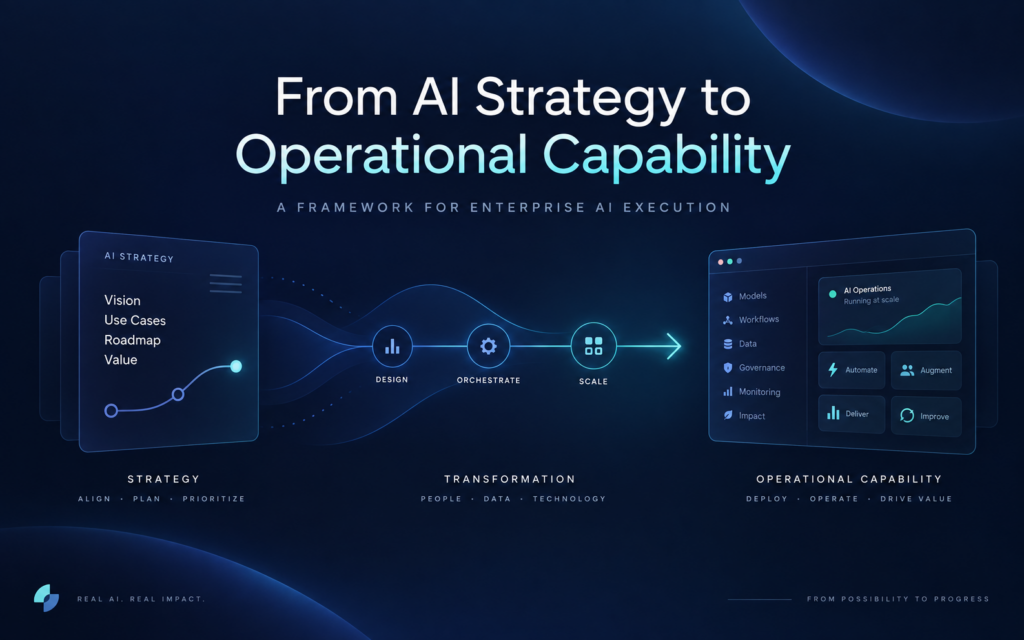
Moving From AI Strategy to Operational Capability
AI strategy provides direction, but operational capability determines whether that strategy produces measurable business outcomes. Moving from planning to execution requires clear priorities, defined ownership, appropriate operating models, integrated systems, production engineering, governance, and ongoing improvement after deployment.
For many organisations, the next stage of AI adoption is not adding another tool or launching another experiment. It is building a repeatable model for identifying the right opportunities, implementing them effectively, and maintaining the systems that become part of day-to-day operations.
Enterprise AI execution provides the structure needed to move from strategic intent to operational use. Organisations that build this capability can approach future AI initiatives with stronger technical foundations, clearer ownership, and a more consistent path from business problem to production system.
Where internal teams need additional implementation capacity, Dedicated AI Forward Deployed Engineers can provide the technical support required to build, deploy, maintain, and improve AI systems while working closely with the teams that own the underlying business processes.