AI Strategy & Implementation
Six Criteria for Evaluating and Prioritising AI Initiatives
The increasing availability of artificial intelligence technologies has created opportunities for organisations to improve business processes, automate routine activities, and address operational challenges. However, identifying a potential AI application does not necessarily mean it is a worthwhile investment.
Some AI initiatives may demonstrate advanced technical capabilities but require significant investment in system integrations, data preparation, ongoing maintenance, or human oversight. Others may involve relatively straightforward solutions that deliver measurable improvements in operational efficiency, service quality, or cost reduction.
For executives responsible for technology investments, the challenge is determining which AI initiatives offer the greatest potential business value while remaining practical to implement within existing operational and resource constraints.
A structured evaluation framework helps organisations compare proposed initiatives based on consistent criteria, including expected business outcomes, technical feasibility, implementation costs, and operational readiness.
This approach enables executives to make informed investment decisions based on measurable business requirements rather than technical demonstrations, vendor claims, or competing departmental priorities.
What Makes an AI Initiative Worth Investing In?
An AI initiative is worth considering when it addresses a clearly defined business problem, offers measurable benefits, and can be implemented within the organisation's operational and financial capabilities.
While technical feasibility is an important consideration, the ability to develop an AI solution does not necessarily justify the investment. Organisations must also assess whether the proposed initiative will deliver sufficient business value relative to its implementation requirements and ongoing costs.
For example, an AI-powered financial reporting system may be technically capable of generating reports from existing business data. However, its value may be limited if the current reporting process is already efficient or if the generated reports require extensive manual verification before they can be used.
In contrast, an AI-assisted document processing system may provide greater operational benefits when it reduces repetitive administrative tasks, improves processing accuracy, and shortens turnaround times.
These examples demonstrate why AI investment decisions should consider the relationship between the business problem, expected outcomes, implementation complexity, and long-term operational requirements.
Executives should evaluate AI initiatives as business investments rather than standalone technology projects. This requires assessing how each solution will integrate with existing workflows, the resources needed for implementation, the individuals responsible for its performance, and the metrics used to measure success.
A consistent evaluation process helps organisations identify initiatives with strong business cases, recognise potential implementation challenges, and determine which opportunities require further assessment before receiving investment approval.
Six Criteria for Evaluating AI Initiatives
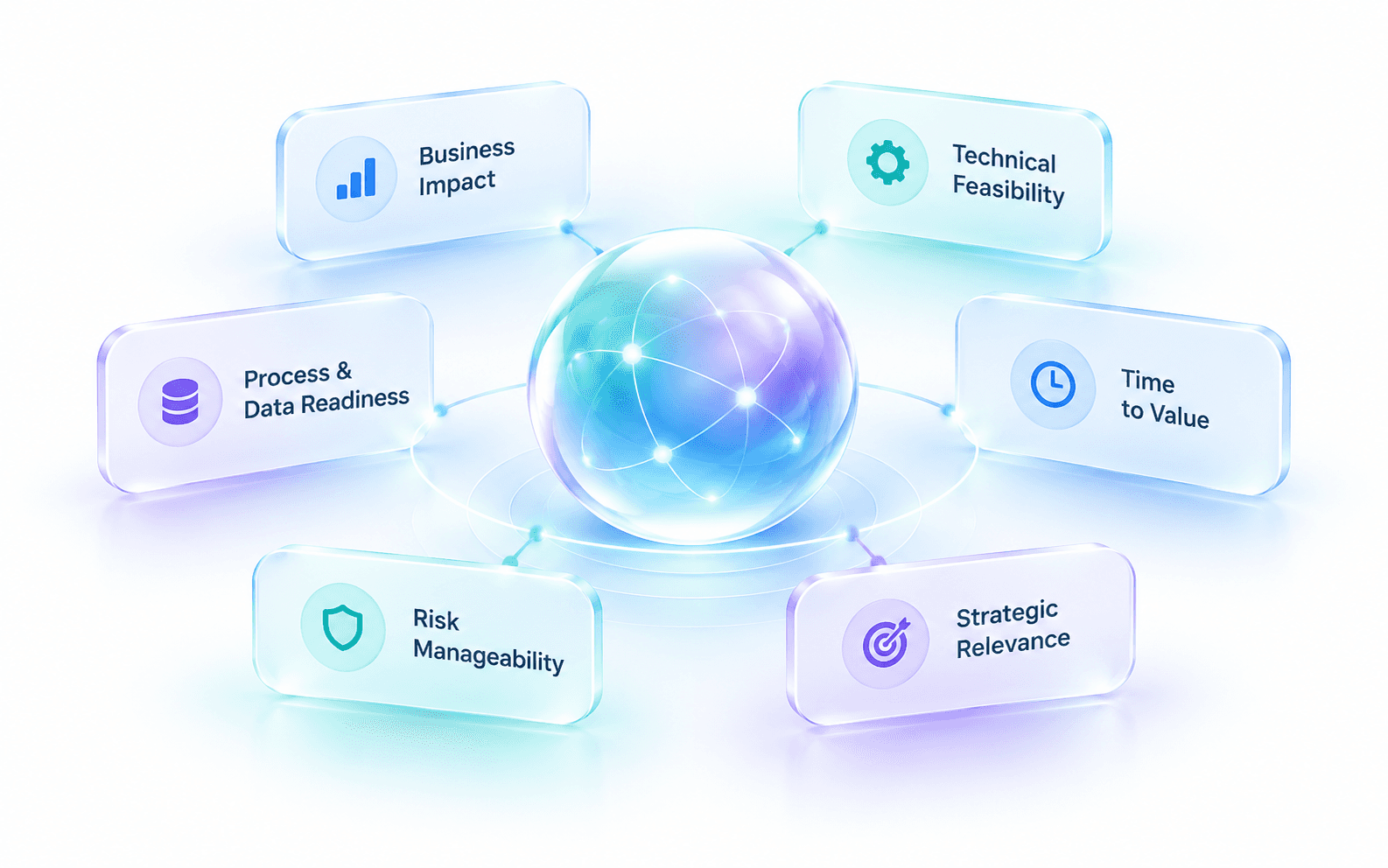
Organisations can evaluate proposed AI initiatives using six criteria that consider business value, technical feasibility, operational readiness, implementation timelines, risk, and long-term strategic relevance.
1. Business Impact: How Much Value Could the Initiative Create?
Business impact evaluates the potential contribution of an AI initiative to an organisation's operational and financial performance.
The assessment should establish whether the proposed solution can reduce operating costs, improve revenue-generating activities, increase productivity, enhance customer experience, or minimise business risks.
For example, an organisation processing thousands of invoices monthly may have a stronger business case for automating invoice administration than one handling a relatively small number of transactions. However, transaction volume should not be the only consideration. A process performed less frequently may still warrant investment if errors result in significant financial losses, regulatory concerns, or customer dissatisfaction.
To determine potential business impact, organisations should examine existing performance indicators, including processing costs, employee working hours, error rates, transaction volumes, service delays, and revenue-related outcomes.
Where possible, expected benefits should be quantified and compared with current performance.
For example, if an AI initiative could reduce monthly processing costs from $20,000 to $14,000, the estimated gross saving would be $6,000 per month. However, this figure does not account for implementation expenses, ongoing AI model usage, maintenance, or other operational costs.
These additional expenses should be considered when determining whether the anticipated improvements justify the overall investment.
2. Technical Feasibility: Can the Initiative Be Implemented Reliably?
Technical feasibility assesses whether an AI initiative can be developed, integrated, and maintained within an organisation's existing technology environment.
Although an AI model may successfully perform a task during a demonstration, deploying the solution into daily business operations often requires additional technical infrastructure and engineering expertise.
Implementation requirements may include integration with existing applications, secure access to internal systems, reliable data pipelines, user permissions, performance monitoring, and procedures for handling system failures.
The evaluation should consider system compatibility, integration complexity, technology maturity, available engineering expertise, and the reliability requirements of the proposed solution.
For example, an AI customer support assistant that retrieves information from a well-organised knowledge base may require relatively straightforward integrations. In contrast, an autonomous AI system responsible for coordinating financial transactions across multiple legacy applications may involve considerably more complex technical requirements.
Technical feasibility should also account for long-term maintenance. AI applications may require ongoing performance evaluations, software updates, integration support, security monitoring, and adjustments as business processes evolve.
A reliable feasibility assessment should therefore consider the complete operational solution rather than focusing exclusively on the capabilities of the underlying AI model.
3. Process and Data Readiness: Are the Foundations in Place?
The success of an AI initiative depends partly on the quality of the business processes and data required to support it.
Process readiness considers whether existing workflows are clearly defined, consistently followed, and supported by established operational procedures. Data readiness evaluates whether the required information is accurate, complete, accessible, and appropriate for the intended application.
For example, an organisation planning to implement AI-assisted management reporting may face difficulties if departments maintain inconsistent financial records, use different reporting definitions, or store essential business information across disconnected systems.
These issues can affect the accuracy and reliability of AI-generated outputs, even when the underlying technology performs as expected.
The assessment should also examine how existing workflows handle exceptions and unusual circumstances. Processes that depend heavily on undocumented employee decisions may require further evaluation before automation can be introduced reliably.
Where process or data readiness is insufficient, organisations may need to standardise information, improve data quality, redesign workflows, or strengthen system integrations before development begins.
These requirements do not necessarily make an initiative unsuitable for investment. However, they can affect implementation costs, project timelines, and the resources needed to achieve the intended business outcomes.
4. Time to Operational Value: When Will Benefits Become Measurable?
Time to operational value assesses how long an AI initiative is expected to take before generating measurable improvements in business performance.
This assessment should consider the entire implementation process rather than the time required to develop an initial prototype.
An AI demonstration may be completed relatively quickly, but introducing the solution into production can require additional development, system integrations, security assessments, employee training, operational testing, and workflow adjustments.
For example, an AI-assisted document processing solution that uses accessible business data and existing applications may begin delivering measurable improvements sooner than a cross-functional automation project requiring extensive integration across multiple systems.
However, initiatives with longer implementation timelines should not automatically receive lower priority. Some projects may establish important technical or operational capabilities that provide greater value over time.
Organisations should compare expected benefits with realistic delivery timelines, implementation costs, and operational dependencies.
This helps identify opportunities for near-term improvements while maintaining investment in projects that support broader business objectives.
5. Risk Manageability: Can the Organisation Control the Consequences?
Risk manageability assesses whether an organisation can identify, monitor, and adequately control the potential consequences of implementing an AI initiative.
AI applications may introduce operational, financial, cybersecurity, privacy, legal, and reputational risks. The significance of these risks depends on the system's intended purpose, level of autonomy, access to sensitive information, and potential impact on business operations.
For example, an AI assistant designed to retrieve information from approved internal documents may present relatively manageable risks when appropriate access controls are implemented.
In contrast, an autonomous AI system authorised to approve financial transactions, modify employee records, or make consequential business decisions may require stronger governance, monitoring, and human oversight.
Risk assessments should establish the actions an AI system will be permitted to perform, the information it can access, and the controls required to maintain accountability.
These controls may include access restrictions, human approval procedures, audit trails, performance monitoring, incident response processes, and clearly defined responsibilities.
The NIST AI Risk Management Framework provides a recognised approach to identifying and managing AI-related risks. Its four core functions, Govern, Map, Measure, and Manage, help organisations manage risks throughout the AI system lifecycle.
Risk assessments should form part of the initial investment evaluation rather than being postponed until deployment.
Where significant risks cannot be adequately managed, organisations may need to limit the system's functionality, introduce additional human oversight, delay implementation, or reconsider the proposed investment.
Expected business benefits should not take precedence over mandatory legal, security, and governance requirements.
6. Strategic Relevance and Reusability: Does the Initiative Support Long-Term Goals?
Strategic relevance evaluates how closely an AI initiative aligns with an organisation's business objectives and whether it can support additional improvements beyond its immediate application.
Some AI investments create reusable technical infrastructure, data integrations, security arrangements, or operational capabilities that can support future projects.
For example, establishing a secure connection between internal business applications and a centralised knowledge repository may initially support customer service operations. The same infrastructure could subsequently support employee assistance, compliance activities, and management reporting.
These broader applications may increase the long-term value of the initial investment.
The evaluation should therefore consider whether a proposed initiative supports strategic priorities, improves existing operational capabilities, and creates opportunities for reuse across departments.
However, potential future applications should not automatically justify significant investment. Organisations need to establish whether those opportunities are realistic, relevant to business requirements, and supported by credible implementation plans.
An initiative should demonstrate a clear business case for its immediate application while offering additional strategic benefits where these can be reasonably established.
How to Build a Weighted AI Evaluation Matrix
After assessing the six criteria, organisations can use a weighted evaluation matrix to compare proposed AI investments and determine their relative priority.
The matrix assigns a percentage weight to each criterion based on its importance to the organisation. Each initiative is then scored against the same criteria, providing a consistent basis for comparison.
The following weighting structure is illustrative and can be adjusted to reflect specific business priorities, operational requirements, and investment objectives.
Evaluation criterion | Weight |
Business impact | 30% |
Technical feasibility | 20% |
Process and data readiness | 15% |
Time to operational value | 15% |
Risk manageability | 10% |
Strategic relevance and reusability | 10% |
Total | 100% |
Each criterion receives a score from 1 to 5, with 1 indicating an unfavourable assessment and 5 indicating a highly favourable assessment.
For risk manageability, a higher score indicates that potential risks are better understood and can be controlled with appropriate safeguards.
The overall weighted score is calculated by multiplying each criterion's score by its assigned weight and adding the resulting values.
Weighted score = Sum of (criterion score × criterion weight)
For example, consider an organisation evaluating an AI-assisted invoice processing initiative.
Evaluation criterion | Score | Weight | Weighted contribution |
Business impact | 4 | 30% | 1.20 |
Technical feasibility | 4 | 20% | 0.80 |
Process and data readiness | 3 | 15% | 0.45 |
Time to operational value | 4 | 15% | 0.60 |
Risk manageability | 4 | 10% | 0.40 |
Strategic relevance and reusability | 4 | 10% | 0.40 |
Total | 100% | 3.85/5 |
In this hypothetical assessment, the invoice processing initiative receives a weighted score of 3.85 out of 5.
The results indicate favourable assessments across business impact, technical feasibility, time to operational value, risk manageability, and strategic relevance. However, the lower score for process and data readiness suggests that additional preparation may be required before implementation.
This could involve standardising invoice records, improving data quality, or integrating existing financial applications.
Although the overall score provides an indication of the initiative's potential, it should not be treated as automatic approval for investment.
Organisations should document the evidence, assumptions, and estimates supporting each assessment. This allows decision-makers to understand the factors influencing project rankings and identify areas requiring further investigation.
Comparing AI Initiatives Across Business Functions
A weighted evaluation matrix is particularly useful when organisations need to compare AI opportunities across departments with different operational requirements and business objectives.
Consider a hypothetical organisation evaluating four proposed AI initiatives using the same scoring criteria and percentage weights.
Initiative | Business impact | Feasibility | Readiness | Time to value | Risk | Strategy | Weighted score |
Customer support knowledge assistant | 5 | 4 | 5 | 4 | 4 | 4 | 4.45 |
Automated management reporting | 4 | 5 | 4 | 5 | 4 | 4 | 4.35 |
Invoice processing automation | 4 | 4 | 3 | 4 | 4 | 4 | 3.85 |
Autonomous procurement approvals | 4 | 2 | 3 | 2 | 2 | 4 | 2.95 |
All scores are hypothetical and are provided to illustrate how the evaluation methodology works.
The customer support knowledge assistant ranks highest, reflecting the assumed combination of strong business impact, accessible information, and favourable operational readiness.
Automated management reporting follows closely, with strong technical feasibility and a relatively short expected time to operational value.
Invoice processing automation also demonstrates potential business value, although its lower readiness score indicates that improvements to existing processes and data may be necessary.
Autonomous procurement approvals receive the lowest score because of the assumed technical complexity, longer implementation timeline, and additional controls required to manage operational risks.
These results provide a structured comparison of the initiatives and highlight the factors influencing their relative rankings.
However, project rankings should not determine implementation order without considering technical dependencies, available resources, and operational constraints.
For example, a highly ranked management reporting initiative may depend on improvements to existing data infrastructure. Addressing those requirements could take priority over immediate development of the reporting solution.
Similarly, an initiative with a lower overall score may still warrant earlier investment if it establishes essential capabilities for several other projects.
The evaluation matrix should therefore support investment decisions rather than replace further assessment and implementation planning. Final priorities should reflect both the scoring results and the organisation's capacity to deliver measurable business outcomes.
Common Mistakes When Evaluating AI Investments
Evaluating AI investments requires more than estimating potential benefits or assessing technical capabilities. Organisations need to avoid common mistakes that can lead to unrealistic expectations, poor investment decisions, and implementation challenges.
Relying on demonstrations rather than operational requirements: A successful AI prototype does not necessarily demonstrate that the solution can operate reliably within existing business processes. Evaluations should consider system integration, security requirements, operational reliability, maintenance, and the technical resources required for production deployment.
Overestimating financial benefits: Projected cost savings may appear attractive when implementation and operating expenses are not fully considered. Financial assessments should account for development, AI model usage, human oversight, system maintenance, and other recurring costs to establish a more realistic estimate of potential returns.
Ignoring process and data readiness: AI solutions cannot automatically resolve poorly defined workflows, inconsistent procedures, or fragmented business information. Where these challenges exist, organisations may need to improve existing processes, standardise data, or strengthen system integrations before introducing automation.
Treating weighted scores as final investment decisions: Although scoring models provide a consistent basis for comparing initiatives, they cannot account for every technical dependency, governance requirement, or strategic consideration. Investment decisions should combine evaluation results with an assessment of operational constraints and business priorities.
Using inconsistent evaluation standards: Applying different scoring definitions or assessment methods across departments can produce misleading comparisons. Organisations should establish common evaluation criteria and scoring guidelines to ensure that proposed initiatives are assessed consistently.
Addressing these mistakes helps organisations make more informed AI investment decisions while reducing the likelihood of committing resources to projects that are not ready for implementation.
How to Use Evaluation Results to Make Investment Decisions
Once AI initiatives have been assessed, organisations should use the findings to determine which projects are ready for implementation, which require further preparation, and which should be deferred or discontinued.
Initiatives can be classified into three categories.
Ready for investment: These initiatives demonstrate clear business value, manageable implementation risks, sufficient technical and operational readiness, and access to the resources required for successful deployment.
Requires additional preparation: These initiatives offer potential business benefits but have unresolved requirements relating to data quality, process readiness, system integration, technical capacity, or governance. Addressing these gaps may improve their suitability for future investment.
Defer or discontinue: These initiatives have limited expected business value relative to their implementation costs, operational complexity, or risks. Projects may also fall into this category when they no longer align with current business priorities.
These classifications provide a practical basis for allocating investment resources without assuming that every technically feasible AI initiative should proceed to development.
Projects requiring additional preparation may become viable once underlying processes, data infrastructure, or technical capabilities have improved. Similarly, deferred initiatives may warrant reassessment when business requirements, available resources, or technology conditions change.
Organisations should periodically review their evaluation results to determine whether initial assumptions remain valid and whether project priorities need to be adjusted.
The objective is to direct AI investments towards initiatives that demonstrate credible business value, meet operational requirements, and can be implemented with the resources available.
Conclusion
Evaluating AI initiatives requires a clear understanding of their potential business value, implementation requirements, and long-term operational implications. Technical feasibility alone is not enough to determine whether an initiative deserves investment.
By assessing business impact, technical feasibility, process and data readiness, time to operational value, risk manageability, and strategic relevance, organisations can make informed decisions about which AI projects are worth pursuing.
A weighted evaluation matrix provides a consistent basis for comparing opportunities across departments. However, investment decisions must also account for implementation dependencies, available resources, governance requirements, and broader business priorities.
Even after identifying viable AI initiatives, organisations may face challenges translating their evaluations into operational systems, particularly when internal teams lack specialised engineering capacity.
Loubby AI helps businesses address this gap by providing forward-deployed AI engineers who work with existing teams to assess technical requirements, identify implementation opportunities, integrate AI into business workflows, and support production deployment. Having the right AI engineering expertise enables organisations to move beyond investment assessments and focus on delivering measurable business outcomes.