



Hiring an AI automation engineer should begin with a clearly defined business process, not a list of software tools.
A candidate may have experience with several automation platforms and AI models but still struggle to turn an unclear operational requirement into a reliable workflow. Building an automation requires more than technical knowledge. The engineer must understand how work moves through the organisation, how systems exchange data, where decisions are made, and what should happen when the workflow encounters an error or an unusual case.
A strong hiring process should assess the candidate’s technical ability, process knowledge, problem-solving skills, and ability to communicate with business teams.
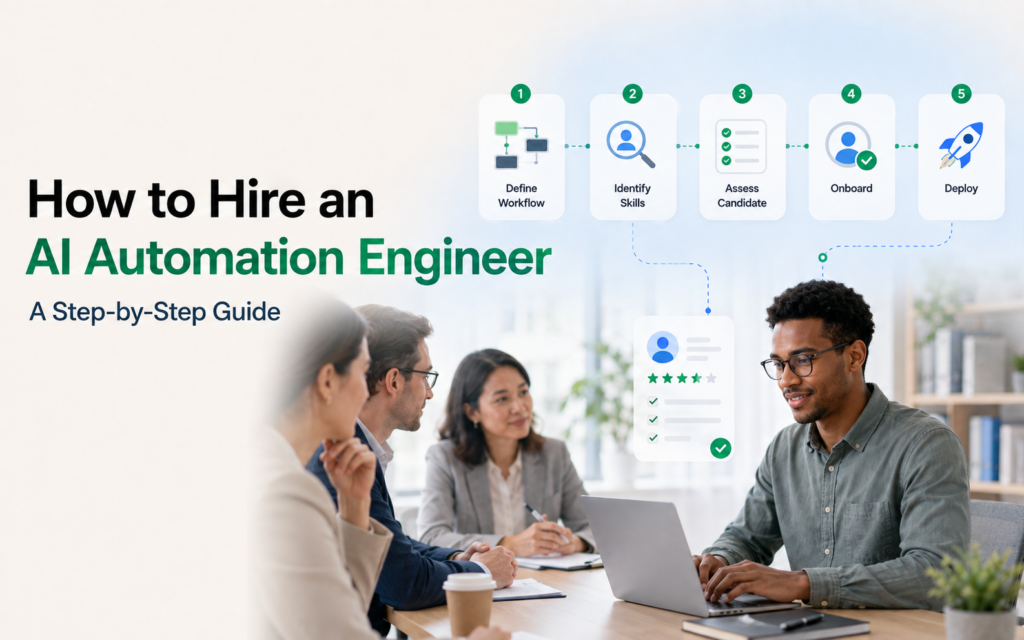
This guide explains how to define the work, identify the required skills, select an engagement model, assess candidates, establish security requirements, and prepare the engineer for a successful start.
Step 1: Identify the First Workflow
Before defining the role, identify the first business process the engineer will assess or automate. This gives the hiring process a clear starting point and helps your organisation determine the technical skills and level of experience required.
Document:
- What starts the process
- The tasks and decisions involved
- The employees responsible for each stage
- The systems and data used
- The number of transactions completed each week or month
- The average completion time
- Common errors or delays
- The expected result
A suitable first project should have clear rules, reliable data, and an outcome that can be measured. Examples include routing customer enquiries, updating CRM records, screening candidate information, preparing recurring reports, processing internal requests, or collecting onboarding documents.
The initial requirement should be specific. A statement such as “we need AI across the business” does not give a candidate enough information to recommend an appropriate solution. A requirement such as “we need to reduce the time spent classifying and routing 2,000 monthly support requests” gives the candidate a defined operating problem.
This distinction matters during assessment. It allows the hiring team to examine how the candidate approaches the process, identifies missing information, evaluates risk, and recommends an implementation method. Choosing the right starting point requires the organisation to identify which business processes are suitable for automation based on their frequency, rules, data quality, operating risk, and expected outcome.
Step 2: Define the Engineer’s Responsibilities
Once the first workflow has been identified, define what the engineer will be responsible for delivering.
The role should be written around business outcomes and technical responsibilities rather than a long list of automation tools. Tools may change, but the ability to analyse, build, test, and maintain workflows remains central to the position.
An AI automation engineer may be responsible for reviewing current processes, documenting requirements, recommending automation priorities, designing workflow logic, connecting internal and external systems, and building AI-assisted steps. The role may also cover testing, deployment, monitoring, technical documentation, maintenance, and training for process owners.
The scope should distinguish between the engineer’s responsibilities and the responsibilities of internal employees. For example, the engineer may own workflow development, testing, and monitoring. The department leader may remain responsible for approving process rules, confirming expected outcomes, and authorising access to systems and data.
Defining this division early reduces delays during delivery. It gives the engineer clear authority within the project while keeping business decisions with the appropriate internal stakeholders.
The job description should also state whether the engineer will focus on one department, work across the organisation, manage an existing automation backlog, or support a defined project. This information will affect the required experience and engagement model.
Step 3: Select the Required Skills
The skills required should reflect the workflows, systems, and technical environment of your organisation. A generic list of popular tools may attract applicants who do not have the experience needed for the actual work.
Automation Platform Experience
The engineer may need experience with platforms such as n8n, Make, Zapier, Airtable, Claude code, Openclaw, Chatgpt, Microsoft Power Automate, or another automation platform used by the organisation.
Platform knowledge should include more than building simple triggers and actions. The candidate should be able to manage workflow conditions, error handling, retries, data transformations, credentials, execution history, and production monitoring.
APIs and Webhooks
Many business workflows require direct connections between applications. The engineer should understand how APIs, authentication methods, webhooks, rate limits, and error responses work.
This knowledge becomes important when an existing connector does not support the required action or when a workflow needs a custom integration. The candidate should be able to review technical documentation, test requests, validate responses, and manage connection failures.
Data Handling
Automation depends on reliable data. The engineer should be able to clean, transform, validate, and move information between databases, spreadsheets, forms, business applications, and external services.
The candidate should know how to manage missing fields, inconsistent formats, duplicate records, and conflicting data. These issues can cause a functional workflow to produce unreliable results.
AI Implementation
For workflows that use AI, the engineer should know how to structure instructions, define expected outputs, validate responses, manage model limitations, and protect sensitive information.
The candidate should also know when AI is appropriate and when a fixed rule is more reliable. A good engineer does not add AI to every stage. The implementation method should match the process requirement.
Programming Skills
Low-code and no-code platforms can support many workflows, but some integrations require custom scripts or services. The required programming language will depend on your existing systems and technical environment.
The candidate should be able to explain when custom code is necessary, how it will be maintained, and how the organisation can avoid becoming dependent on undocumented scripts.
Process Analysis and Communication
The engineer must be able to interview process owners, document requirements, identify exceptions, explain technical options, and report issues in clear business terms.
This skill is particularly important when the engineer works with non-technical departments. The person should be able to convert business requirements into technical workflow logic without losing important operating details.
Step 4: Choose an Engagement Model
The right engagement model depends on the duration of the work, the urgency of the project, your available budget, internal management capacity, and the level of support your organisation requires.
Review these factors before choosing permanent employment, contract engagement, project delivery, or staff augmentation.
Permanent Employment
Permanent employment may be suitable when the organisation has consistent long-term automation work, an internal technical management structure, and the capacity to recruit and retain an engineer.
This model gives the organisation a team member who can develop extensive knowledge of its systems and operations. It requires a longer-term financial commitment and places recruitment, onboarding, performance management, and retention responsibilities on the employer.
Contract Engagement
An independent contractor may be suitable for a short assignment with a clearly defined scope.
This option can provide flexibility, but the organisation usually takes responsibility for sourcing, technical assessment, onboarding, management, and continuity. The organisation should also plan how completed workflows will be documented and maintained after the contract ends.
Project Delivery
Project delivery may be suitable when the organisation has a defined implementation with agreed requirements, milestones, timelines, and outputs.
The provider takes responsibility for delivering the agreed project. Changes made after approval may affect the scope, delivery time, or cost. This model may be less suitable when the organisation expects priorities to change regularly.
Staff Augmentation
Staff augmentation may be suitable when an organisation needs a dedicated engineer who can work directly with its team, respond to changing priorities, and provide ongoing technical support.
Under this model, the engineer works within the organisation’s existing processes for the duration of the engagement, while the provider manages recruitment, onboarding, and engagement support. This allows the organisation to add technical capacity without immediately creating a permanent position.
Organisations evaluating this option should understand how AI automation engineer staff augmentation works and how it differs from permanent employment, contract engagement, and project delivery.
The final decision should reflect the duration and volume of work, the urgency of the requirement, internal management capacity, security requirements, and the level of flexibility needed.
Step 5: Assess Candidates With a Realistic Task
A practical assessment can show how a candidate approaches the type of work they will perform. The exercise should reflect a realistic business process without exposing confidential information or requesting unpaid production work.
Provide a short process description and ask the candidate to map the workflow, identify missing requirements, recommend an implementation approach, and explain how errors will be managed. The candidate should also describe the required permissions, monitoring plan, and main delivery stages.
During the interview, ask questions such as:
- Which parts of this process should remain manual?
- What could cause the workflow to fail?
- How would you prevent duplicate or incomplete records?
- How would you test AI-generated output?
- What would you monitor after deployment?
- What technical documentation would you provide?
- How would you respond if a connected system changed?
Strong answers should connect technical decisions to the business process. The candidate should explain the reason for selecting a particular approach, the risks involved, and how the workflow will be maintained.
Be cautious of candidates who focus only on how quickly they can build the automation. Speed is useful, but it should not replace proper discovery, testing, security, documentation, and monitoring.
Step 6: Set Security and Governance Requirements
Security requirements should be established before the engineer receives access to company systems or data.
Create a written access plan that defines the applications the engineer may use, the data they may view, the permissions required, and how credentials will be stored. It should also distinguish between development, testing, and production access.
Give the engineer only the level of access required for the work. Where possible, use role-based permissions, separate test environments, activity logs, and approval requirements for sensitive actions.
The organisation should define who can authorise changes to a production workflow and how those changes will be documented. It should also establish a process for removing access at the end of the engagement.
For AI-assisted workflows, review the type of information sent to external models or services. Sensitive customer, employee, financial, or confidential business data may require additional controls. The engineer should be able to explain how data is transmitted, processed, stored, and protected.
Security should form part of the workflow design from the beginning. Adding controls after deployment can create avoidable risk and require substantial rework.
Step 7: Prepare a Structured Onboarding Plan
Fast onboarding depends on preparation. An engineer cannot begin effectively if system access, process information, and decision-makers are unavailable.
Before the start date, appoint an internal process owner and a technical contact. Prepare the required accounts, permissions, current process documents, and information about the systems involved. Confirm the first workflow, expected result, communication channel, reporting format, and review schedule.
During the first stage of the engagement, the engineer should validate the current process, document open questions, confirm the technical approach, and agree on the delivery stages.
The process owner should be available to explain exceptions and approve business rules. The technical contact should support access, security, and integration questions. Clear responsibilities reduce delays and prevent the engineer from making assumptions about the process.
Onboarding should also cover documentation standards. The organisation should specify how workflow logic, system connections, credentials, known limitations, failure procedures, and maintenance requirements will be recorded.
How to Measure the Engineer’s Work
The engineer’s performance should be measured through the results of the workflows rather than the number of automations built. The appropriate measures will depend on the process, but may include:
- Processing time: Compare how long the process takes before and after deployment.
- Manual hours saved: Measure the amount of employee time removed from repetitive tasks.
- Error and rework rate: Track changes in the number of errors, incomplete transactions, and repeated work.
- Automation completion rate: Measure the percentage of transactions completed without manual intervention.
- Workflow failure rate: Track how frequently the automation fails or requires technical attention.
- Issue resolution time: Measure how quickly the engineer identifies and resolves workflow failures.
- Employee adoption: Review whether employees use the workflow correctly and consistently.
- Cost per transaction: Compare the cost of completing each transaction before and after automation.
Record a baseline before development begins. Without reliable baseline data, the organisation cannot determine whether the workflow improved performance.
The quality of the implementation should also be reviewed. A successful workflow should be secure, documented, monitored, and maintainable. It should manage expected exceptions and provide clear information when an error requires human attention.
Performance reviews should consider business results, technical reliability, issue resolution, documentation quality, and communication with process owners.
How Loubby AI Helps Organisations Hire AI Automation Engineers
Loubby AI provides dedicated AI automation engineers who work directly with organisations to develop workflows, connect systems, test automations, monitor performance, and provide ongoing technical support.
We manage the recruitment and onboarding process and can provide an engineer with three business days. Your engineer works with your team to assess selected processes, define requirements, build and integrate workflows, monitor performance, resolve technical issues, and improve deployed automations.
You can hire an engineer based on your preferred engagement model, project scope, workload, and support requirements. This gives your organisation the flexibility to secure technical support for a defined project, an active automation backlog, or ongoing workflow development.
To begin, identify the first process you want to automate, the systems involved, the person responsible for the process, and the outcome your organisation expects. This gives the engineer a defined starting point and keeps the engagement aligned with your operating priorities.
Conclusion
Hiring the right AI automation engineer requires more than assessing knowledge of automation platforms. The engineer must be able to analyse business processes, connect systems, manage data, test normal and exception cases, document technical decisions, and maintain deployed workflows.
A strong hiring process begins with one clearly defined workflow. From there, your organisation can identify the required skills, select an appropriate engagement model, conduct a practical assessment, establish security requirements, and prepare a structured onboarding process.
If your organisation needs dedicated technical support to move its automation projects forward, hire an AI automation engineer through Loubby AI to get started.