





AI pilots are useful because they allow organisations to test an idea before committing significant engineering resources to production. But proving that AI can perform a task is not the same as proving that the use case is worth deploying across the business.
That distinction is becoming increasingly important as enterprise experimentation grows. Deloitte’s 2026 State of AI in the Enterprise research found that only 25% of surveyed organisations had moved 40% or more of their AI pilots into production. Moving from experimentation to production remains a meaningful hurdle.
Not every pilot should make that transition. A pilot may work technically and still fail to justify the cost, integration effort, operational change, risk, or long-term maintenance required to run it in production.
The purpose of a pilot should therefore be to answer a more important question than “Can we build this?” It should help the organisation determine “Is this worth operating at scale?”
When Should an AI Pilot Move Into Production?
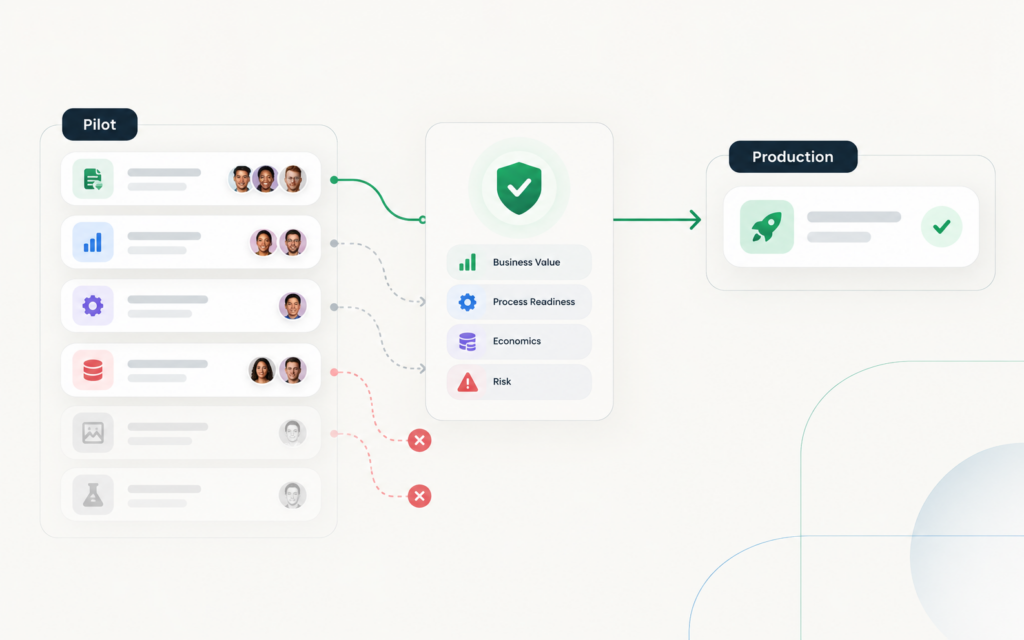
An AI pilot should move into production when there is sufficient evidence that the system can improve a meaningful business outcome and operate reliably within the organisation’s existing environment.
That means looking beyond model accuracy or an impressive demonstration. The organisation needs to understand the expected business value, whether the underlying process is ready, which systems and data must be connected, how risks will be controlled, what production will cost, and who will own the system after launch.
A successful pilot should reduce uncertainty across these areas. If the experiment proves the AI capability but leaves the business case or operating requirements unresolved, more work is needed before production investment is justified.
Why Some AI Pilots Should Stop
There is nothing inherently wrong with ending a pilot. In many cases, discovering that an idea should not receive further investment is a useful outcome.
A pilot can reveal that the expected business value is too limited, the underlying process is not ready, or the requirements for production would introduce more cost, complexity, or risk than the opportunity can justify. Identifying these issues early helps organisations avoid committing additional engineering resources to initiatives that are unlikely to deliver sufficient value.
Several conditions should make organisations reconsider whether an AI pilot belongs in production.
1. The Business Value Is Too Small
Technical feasibility does not guarantee meaningful business value.
AI may perform a task extremely well, but if that task represents a small amount of cost, time, revenue, or operational friction, the production system may never generate enough value to justify building and maintaining it.
BCG’s 2026 analysis of why AI pilots fail to create business value gives the example of a manufacturer considering AI to reduce production waste. Waste accounted for less than 1% of cost of goods sold, meaning that even eliminating it completely would not have generated enough value to justify the AI solution.
The question should therefore be broader than whether AI can improve the activity. Organisations should ask whether improving that activity will materially affect the business.
2. The Pilot Improves a Task but Not the Overall Outcome
A common AI pilot demonstrates that one activity can be performed faster. That does not necessarily mean the process becomes faster, cheaper, or more effective.
For example, AI might reduce the time required to prepare a report from several hours to minutes. If employees still spend days gathering information, resolving discrepancies, waiting for approvals, and manually distributing the final output, the overall process may change very little.
BCG’s research on AI pilots describes a similar case where AI reduced a task from ten days to one day, but the customer still waited ten days because the surrounding process had not changed.
Before moving a pilot into production, teams should assess whether the system improves the end-to-end outcome or simply accelerates one activity inside an inefficient workflow.
3. The Process Is Not Ready for AI
Sometimes the pilot exposes a problem that AI cannot solve on its own.
The underlying workflow may depend on inconsistent data, undocumented decisions, manual workarounds, unclear ownership, or employees using experience to resolve exceptions that have never been formally defined.
Moving directly into production can force engineers to build around these weaknesses rather than addressing them.
A structured AI automation readiness assessment can help determine whether the process, data, ownership, and supporting systems are sufficiently prepared before further engineering investment is made.
Where the process itself is weak, improving it first may create more value than immediately expanding the AI system.
4. Production Changes the Economics
Pilots can make AI systems appear cheaper than they will be in production.
A pilot may operate with a limited number of users, manually prepared data, temporary integrations, and close supervision from the project team. Production introduces additional requirements such as authentication, application integrations, monitoring, security controls, logging, human escalation, infrastructure, evaluation, and ongoing engineering support.
Those costs need to be included in the production decision.
A use case that appears attractive when measured against pilot expenditure may have a very different return once the full cost of deployment and maintenance is understood.
The question is therefore not simply whether the pilot produced value. It is whether that value remains attractive once the system is operated under real business conditions.
5. Integration Effort Outweighs the Expected Value
Enterprise AI rarely operates in isolation. A production system may need access to CRM data, internal documents, ERP systems, communication platforms, approval workflows, databases, or other business applications.
Some of these integrations are straightforward. Others require substantial custom engineering, security work, data preparation, or changes to existing systems.
High integration complexity does not automatically make a project unattractive. The issue is whether the expected value of the use case justifies that complexity.
When it does not, the organisation may be better served by reducing the scope, waiting until shared infrastructure is available, or directing engineering resources toward another opportunity.
6. The Risk Cannot Be Controlled Appropriately
A pilot may perform well when it operates in a controlled environment but become significantly more complicated once the AI system is allowed to interact with customers, employees, sensitive information, or enterprise applications.
Production design needs to establish what the system can do independently, what requires approval, how uncertain cases are escalated, what information the AI can access, and how actions are recorded.
Where appropriate controls cannot be implemented reliably or economically, the use case may need to remain limited.
This does not necessarily mean abandoning the AI capability. The workflow could be redesigned so the system prepares information or recommendations while a person retains responsibility for higher-risk decisions and actions.
7. There Is No Clear Owner After Launch
A pilot can survive with temporary project ownership. A production system cannot.
Someone needs responsibility for the business outcome, while technical responsibility needs to cover system performance, integrations, monitoring, failures, maintenance, and future changes.
If nobody is prepared to own those responsibilities once the pilot team moves on, the system is not operationally ready.
Production ownership should be established before deployment rather than becoming a question after the system has already entered the business.
What Should an AI Pilot Prove Before Production?
A pilot does not need to answer every possible question about the final system. It should, however, provide enough evidence for leadership to make a credible production decision.
Before further investment, the organisation should be able to answer six questions:
- Does the use case improve a meaningful business outcome?
The expected value should extend beyond making an isolated task faster. - Is the underlying process ready?
The workflow, data, ownership, decisions, and major exceptions should be sufficiently understood. - Can the system operate within the existing technology environment?
Required applications, data sources, integrations, and permissions should be realistically accessible. - Can the operational risk be controlled?
Human oversight, escalation, security, monitoring, and decision boundaries should match the risk of the use case. - Do the production economics still make sense?
Expected value should be compared with the full cost of integration, infrastructure, deployment, and ongoing maintenance. - Who will own the system after deployment?
Business and technical responsibility should already be clear.
If several of these questions remain unanswered, the next step does not have to be production. The organisation can refine the pilot, redesign the process, reduce the scope, resolve a dependency, or stop the initiative.
A Good Pilot Does Not Always End in Production
The purpose of enterprise AI experimentation should not be to maximise the number of pilots that reach production. It should be to improve the quality of investment decisions.
BCG’s 2026 research found that companies generating stronger AI value tend to concentrate on a smaller number of high-impact initiatives rather than spreading investment across disconnected experiments. This makes the ability to stop weaker initiatives just as important as the ability to scale stronger ones.
A pilot has done its job when it provides enough evidence to determine what should happen next. Sometimes that means production. Sometimes it means redesigning the workflow or waiting until the organisation is better prepared. And sometimes the right decision is to stop investing.
For use cases that demonstrate clear value and production readiness but require additional implementation capacity, embedded AI engineers can support the transition from validated concept to production while remaining closely connected to the workflow and business outcome the system is intended to improve.